California Should Regain Its Lead in Setting National Trends and Stop Building New Prisons and Jails

from California Progress Report

By Emily Harris and Isaac Ontiveros

Across the country, headlines show a new trend of nationwide prison closure. A recent report by the Sentencing Project notes that, to date, 13 states in the US have closed or are considering closing some of their correctional facilities, reversing a 40-year trend of prison expansion. States initiating prison closures include New York, Texas, Colorado, Connecticut, Georgia, Michigan, Florida, Nevada, North Carolina, Oregon, Rhode Island, Washington, and Wisconsin. Michigan, for example, has closed 21 facilities and has prioritized re-entry services for people returning to their communities from prison.
Fiscal crises have definitely fueled the trend, but reforms in sentencing and parole policies have also resulted in less demand for prison space. In turn, the closures have freed up millions and millions of dollars that could be used into rebuilding programs and services proven to keep people out of prison and in their communities.
California, unfortunately, is moving in the opposite direction. Despite an ongoing fiscal crisis in California, there are currently 13 costly prison and jail expansion projects moving forward using our states scarce resources, and we anticipate more construction to roll out under phase II of the notorious AB 900 legislation. AB 900 was signed into law in May of 2007, authorizing at least $7.4 billion in lease revenue bonds for the construction or expansion of our State’s prisons, jails and re-entry centers and marks the largest prison construction scheme in human history.
In May the U.S. Supreme Court issued a ruling in a lawsuit against the state involving deadly prison overcrowding. Specifically, the court upheld the ruling of a federal three-judge panel requiring California to reduce overcrowding in its prisons from nearly 200% to 137.5 % of its “design capacity” within two years. The court’s decision will almost certainly result in some of the most dramatic changes to the state’s prison system in decades. So far, the state’s plan for reducing the prison population relies heavily on shifting prisoners from state lockups to county jails, transferring more people to out-of-state private prisons, and building thousands more prison and jail cells.
As we see it, we could continue down this scary, shortsighted path and waste billions of dollars on prison and jail construction to comply with the Supreme Court ruling. But where will this end? How will we pay for the long-term operating costs? And what about the social costs? Will education, health and human services and our shrinking social safety net continue to be jeopardized to cover the bill for mass imprisonment?
The Supreme Court order and our growing budget crisis provide our state with a unique opportunity to change our approach to public safety. Instead of continuing to push forward these unnecessary and costly prison and jail expansion projects, now is the time to look to these other states that have safely reduced their prison populations by implementing basic and modest parole and sentencing reform. The nonpartisan Legislative Analyst’s Office bolstered that argument after releasing a report recommending that California reconsider its costly construction program.
A place to start would include amending or repealing three strikes law, expanding medical parole, utilizing compassionate release, paroling elderly prisoners and reforming non-violent property and drug sentencing laws. Recent polls show the majority of Californians support these simple solutions. However out of touch our Governor and other lawmakers seem to be, we’d wager that Californians would be willing to take even greater steps against further prison crisis. If we want the safe and healthy California we all deserve, we need to make smart, long-lasting decisions that put our state back in a position of national leadership.
~~~~~~~~~~~~~~~~~~~~~~~~~~~~~~~~~~~~~~~~~~~~~~~~~~~~~~~~~~~~~~~~~
Emily Harris is the Statewide Coordinator for Californians United for a Responsible Budget. Isaac Ontiveros is the Communications Director for Critical Resistance.

Pelican Bay Hunger Strike, Day 2: Parole, Snitch, or Die

Yesterday’s panel on the Pelican Bay hunger strike featured, among other speakers, the impressive and insightful Keramet Reiter, a PhD candidate at UC Berkeley whose dissertation examines the history and development of the supermax. Reiter’s piece Parole, Snitch, or Die, is a concise history and thorough analysis of California’s supermax prisons and their discontents. It makes for an excellent read and I can’t recommend it enough. Using a combination of quantitative data and interviews with CDCR officials, Reiter lays out the process against which the inmates are protesting: the little-studied process of paroling through “snitching” and debriefing.

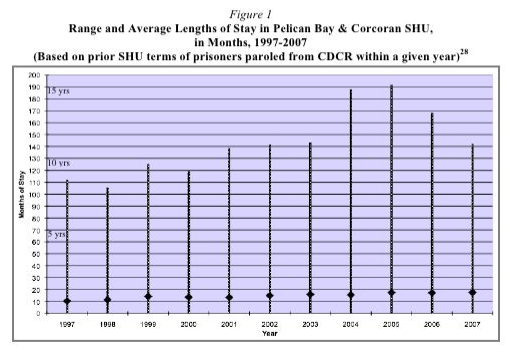
While, initially, at inception the idea behind the supermax was to handle prison violence by removing gang leaders from general population, this design has gone wrong. There is no evidence of a decline in violence as a result of using supermax incarceration and/or SHU units. Moreover, the isolation was never intended to become indefinite. However, Reiter’s data suggests that “many supermax terms are indefinite, providing few ways out, and. . . the average term is longer than eighteen months at Pelican Bay.” While the maximum lengths of stay in the SHU have declined between 2005 and 2007, the average length has steadily increased.

From its inception, Pelican Bay raised concerns that it would be excessively used. Today, inmates with gang ties are indefinitely assigned to the SHU units. The definition of gang membership is loose and vague, and therefore “the validation process is rather discretionary; any documentation of potentially illegal group activity could lead to gang validation.” Disciplinary offenses, leading to definite terms at the SHU, can range from attempted murder to spitting on an officer.

Has lockup at the SHU reduced violence? Not necessarily, as the data suggests. In fact, comparing levels of violence in Pelican Bay and Corcoran with that of other high-security institutions without supermax units suggests that “the supermax units might actually be aggravating problems with violence.”

There’s a lot more in the piece and I recommend reading it in its entirety. We will continue reporting on the supermax, solitary confinement, and the strike, for the weeks to come.

Food and Nutrition in Correctional Institutions

You’re all invited to join us for a special event on Food Day, Oct. 24, 2011, at UC Hastings. If you’re interested in food and social justice, especially in the context of prisons, that’s the place to be!

The UCSF / UC Hastings Consortium on Law, Science & Health Policy is sponsoring a conference entitled “Food Deserts: Legal, Social and Public Health Challenges” on Food Day, October 24, 2011 with keynote speech by Dr. David Kessler, former Commissioner of the FDA. The conference will bring together scholars from the health sciences and the law, as well as policymakers, activists, and food industry members, to discuss two important aspects of “food deserts,” places where access to a nutritionally-adequate diet is severely restricted.


One panel, “Nourishing Our Neighborhoods: Insights from Law, Planning, and Industry,” will cover the broad issue of geographical food deserts, usually urban areas inhabited by mostly-poor people whose transportation and finances are limited, where food sellers are predominantly small stores that cannot stock a wide variety of fresh food items, and where full-service grocery stores hesitate to locate. Are there policies (such as those in zoning rules) that could be changed to enable oases in these food deserts? What impact does, for example, the addition of a full-service grocery store have on the health of the neighboring area?


Another panel, “Food and Nutrition in Correctional Institutions,” will consider issues relevant to prisons and jails. While food offerings must meet certain basic caloric and nutritional requirements, the institutional nature of food preparation and food service might make that food less than appealing, and the healthier elements of meals might well be those not regularly or fully consumed. The supplemental food offerings – those for sale in these institutions – are not likely to be nutritious. Some research suggests that improved nutrition in prisons leads to improved penal outcomes. If that is so, what policy changes should be implemented? Would such changes be cost-beneficial, considering penal outcomes and the government’s responsibility for health care of prisoners?

Our panelists for the prison panel will include doctors, legal scholars, CDCR personnel, and people running organic garden programs in prison. It’s going to be a fascinating panel.

At 5 pm, Dr. David Kessler, former Commissioner of the United States Food and Drug Administration and Professor of Pediatrics and Epidemiology and Biostatistics, UCSF, will give the keynote address on The End of Overeating.

The event is free and open to the public, but requires registration. We will be offering CME and CLE credits for attending doctors and lawyers, respectively.

RSVP through the UCSF/UC Hastings Consortium or
RSVP through the Food Day website

Pelican Bay Strike Panel Opening Remarks

Today’s panel on the Pelican Bay hunger strike was well attended and prompted some interesting discussion. A few people emailed asking me to post my opening remarks on the blog.

Good afternoon,

Don’t you know? Talking about a revolution, it starts like a whisper. But this panel is much more than a whisper. It is a strong, loud cry against a dehumanizing, cruel incarceration regime that demeans our society in its entirety. To shed light on these practices, a number of Hastings student organizations have invited former inmates, family members of inmates, and legal professionals, who will discuss this afternoon one of the most exciting and electrifying instances of protest against the evils and inadequacies in our correctional system.

The strike started, and is resuming, at a momentous time in American criminal justice and in California in particular. The State of California is still reacting to the Supreme Court’s decision in Brown v. Plata, affirming a federal three-judge panel decision that population reduction is the only way to combat a prison medical system beneath minimal constitutional standards.

As impressive as the Plata decision is, I suspect several broader developments created the fertile ground upon which it sprouted. For many years, it would be very hard to envision a Supreme Court with this political composition approving such an order. Prisons have been, for decades, invisible cities, out of the public mind and eye, and what happened within them, be it cumbersome ineffective rehabilitation programs or plantation-style farms rife with racial cruelties, interested very few people beyond practitioners and scholars. Supermax institutions and SHU units were particularly immune to critique, because for very long—too long—the public was kept in the dark about the realities within walls, and when these institutions did make headlines, the public was told that the people held there for 22 and a half- hour days in isolation were subhuman, violent beings who deserved such treatment. Ironically, solitary confinement was one of the first incarceration practices used in the early penitentiaries of the 18th and 19th centuries. The solitude was designed to make inmates engage in penitence and reflection. The practice has remained as extreme and harmful as it ever was, but it changed in two important ways. First, the rationale for solitary confinement is no longer penitence and rehabilitation, but mere incapacitation and risk management. And prison sentences today are exponentially longer than they were in the early days of prisons. These two factors – the growing disinterest in reform and change, and the extended periods of time in which people are subjected to solitary confinement – make this practice even more perverse now than it was at its inception. Social scientists researching the effects of such regimes are on agreement regarding the immense harm of placing humans in
solitary confinement.

In reigniting the fire of protest against the deplorable conditions at SHU units, about which you will soon hear from our panelists who have experienced them as inmates, supporters, and family members, Pelican Bay inmates join an honorable tradition of inmate-initiated struggle and reform. A month ago we celebrated the 40th anniversary of the Attica uprising, a defining moment in criminal justice politics. In the 1960s, Fred Cruz and his friends in Texas penitentiaries brought the Texan correctional giant to its knees and dismantled a cruel, dark system through habeas writs written on smuggled toilet paper. And in California, the radical prison movement, beginning with Caryl Chessman’s writings and continuing with Malcolm X, Angela Davis, and George Jackson, has generated attention to the cause of inmates. Most recently, inmates in Georgia engaged in a strike against cruel, inhumane correctional practices; the system they raised their voices against is the same system that, last week, executed a probably innocent man. The execution of Troy Davis made millions of people rise in support and decry an outrageous miscarriage of justice. It is possible to make allies against inhumane regimes that exceed what is psychologically and humanly tolerable. The strength of nonviolent protest coming from people whom the public has been accustomed to read about as subhuman, violent beings engaged in rioting and cruelty, is overwhelming.

Some feel that the time for such activism has passed; that the 1960s and 1970s presented a unique moment in American history, in which civil rights movements and the Warren Court created the perfect storm for radical prison movement. For many decades since, the combination of law-and-order political rhetoric from actors across the entire political spectrum, and managerial warehousing practices infected with rampant profiteering and privatization, created a reform-resistant wall. But, as I mentioned earlier, this is changing before our very eyes. We live in extremely difficult financial times. The public is attentive to the message that our out-of-control correctional monster is financially unsustainable. The practices that Pelican Bay inmates are protesting are the product of a hungry, ever-expanding carceral world that we can no longer afford—morally, organizationally and financially. Public opinion is changing and, have no doubt, decisionmakers are listening and responding. The state is currently engaged in a process of realignment, shifting much of its prison population from state prisons to county jails. The parole system is under revision. And, for the first time in forty years, last year the U.S. prison population decreased. These dramatic changes cannot be underestimated.

This act of protest is, therefore, occurring at a unique historical moment in which taxpayers, practitioners and officials may be more open to the possibility of reform advocated for through nonviolent means. It is, therefore, lamentable that the July hunger strike received so little media coverage in mainstream newspapers. But we are here to change that. Our hosts this afternoon are taking an important step to change this and break the silence.

Audience members may disagree about the dangers of violent crime and the means to fight it. If you are agnostic about the merits of this hunger strike, thank you for coming here this afternoon with an open mind willing to become informed aboutthis side of the debate. Listening to the people who are the most disenfranchised and the least listened to in the American political arena is an important experience. And if you are convinced that this way of doing things must be abolished, that solitary confinement and debriefing should end, thank you for coming here today to do something about it. Finally, the tables are starting to turn.

I wish you all an interesting and informative afternoon.

Today! Panel on the Pelican Bay Hunger Strike

This afternoon we will hold a panel at UC Hastings, organized by numerous student associations, on the Pelican Bay hunger strike, which resumes today. The panel is free and open to the public.

Where: UC Hastings, 198 McAllister Street, San Francisco, CA – at the LBM lounge in the ground floor

When: Monday, 3:30pm-5:30pm

Who:

  • Marilyn McMahon (Prison Focus)
  • Keramet Reiter from UC Berkeley, whose dissertation examined the emergence of the superman
  • Marie Levin, family member of SHU inmate
  • Dorsey Nunn (Legal Services for Prisoners with Children, All of Us or None)

Caitlin Henry will moderate and I’ll make opening remarks. We hope to see you there. If you’re a blog reader, come by and say hi.

Troy Davis and the Civilizing Process

What could possibly be left to say on the aftermath of Troy Davis’ execution? Words on the evil of the death penalty? On innocence and guilt and doubt? On the inability of the law enforcement mechanism to accept the possibility of mistake? Just in case you missed some of the commentary, here were my favorite picks:

Yesterday, my  criminology students and I discussed Norbert EliasThe Civilizing Process. Written in 1939, the book was forgotten for several years as Elias’ career was derailed by the second World War. A Jewish European scholar, Elias worked in exile and relative obscurity until he arrived in England, where he resumed an important place in the sociological universe. Still woefully undeacknowledged among the pantheon of sociological giants, Elias’ work deserves much praise and recognition.

In The Civilizing Process, Elias argues that the 18th century was a “watershed” time that saw a profound top-down change in European society: From a society of knights to one of courtiers. This change, the reaction to the formation of the modern centralized state, was accompanied by a profound change in etiquette and social sensibilities, including the development of various subtleties in interpersonal interaction, table manners, bodily functions, and the like. Among other things, says Elias, our bloodthirstiness and daily exposure to violence have decreased. While life in the middle ages included a daily unmitigated experience of violence and a relishing of violence, we came later to see it as distasteful.

Much of Elias’ theory has been confirmed by later studies. Indeed, the rate of violent crime, especially homicide, has been repeatedly proven to have declined in the last few centuries. One explanation for the decline of violence is that the centralized state came to resume the functions of violence usage as proxy for citizens, and those, in turn, became more sublimated, more docile, and more amenable to its power and thus less violent on their own initiative (the increased regulation and decrease in the use of duels is a case in point.)

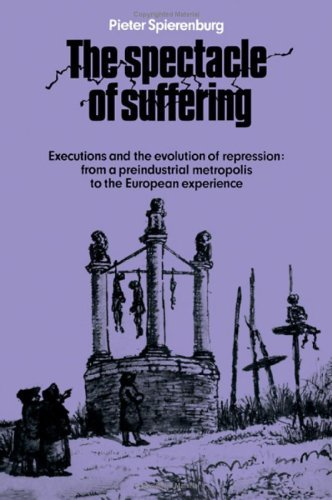
But the state changed its practices, too. Following Elias, excellent Dutch historian Pieter Spierenburg’s The Spectacle of Suffering points out the change in how executions were carried out in Europe. The “watershed” years, and the years to follow, saw fewer and fewer executions, and a marked toning-down of the pomp and circumstance that surrounded them. According to Spierenburg, the society of courtiers increasingly lost its taste for public corporal rituals and moved away from them.

So, what do we have now? Perhaps the ultimate sublimation: An execution that is nothing more than a sad coda to years of quiet confinement and increasingly technical litigation. Conducted away from the public eye, its only witnesses are those closest to the case–the offender’s family and the victim’s family–arguably the parties who retain some of that pre-civilizing, raw connection to the act and the social connection. The story is mitigated by its sanitized media coverage. As Austin Sarat argues in When the State Kills, the coverage removes our visceral connection to the violence we delegated to the state; and as Frank Zimring argues in The Contradictions of American Capital Punishment, it masks its origins in lynching and public relishing of violence.

The true strength of the protest in Troy Davis’ case was in breaking this boundary of sublimation and sanitation. Millions of people around the world were moved by Davis as a symbol of human suffering. They did not fail to recognize this act for what it is, even when carried out away from the public eye and using advanced chemicals, needles and machines. They saw the racial overtones and origins of the practice and the way they played out in this particular case; and they did not shy away from expressing their utmost distaste with it and the deep ways in which it offended their sense of justice. Distressing as this was–an unsatisfying coda to the tragic death of Mark McPhail, who deserved a better police force and a better inquiry as to his slaying–the public reaction, a vehement expression of our distaste for the modern “machinery of death” and ability to see it for what it is, was an important moment in American history, whose ramifications may bear fruit in the ballot box and in the courtroom.

——
Props to my Theoretical Criminology students, whose commentary yesterday prompted much of this post. 

BREAKING NEWS: No Reprieve for Troy Davis

The Supreme Court rejected Troy Davis’ last minute appeal for a delay. The New York Times reports:

The United States Supreme Court rejected a last-ditch request to step in late Wednesday to stay the Georgia execution of Troy Davis, who was convicted of gunning down a Savannah police officer 22 years ago, after Mr. Davis filed an eleventh-hour plea Wednesday with the high court.
His execution, by lethal injection, had been set to begin at 7 p.m., but Georgia prison officials waited for the court’s decision late into the evening. It took the court more than four hours to issue its one-sentence order.

This is a dark day for truth, justice, mercy, and the appellate process. Thank you to everyone who signed petitions, emailed, shared information about the case on social networks, and offered help through Amnesty, the NAACP, and other organizations. May this be the last time a probably innocent person is put to death.

Prison Hunger Strike Panel at UC Hastings

The Hastings Race and Poverty Law Journal, with Hastings Prisoner Outreach, La Raza Law Students Association, Black Law Students Association, Hastings National Lawyers Guild, Hastings Students for Sensible Drug Policy and Hastings Criminal Law Society are organizing a panel on the upcoming Pelican Bay hunger strike.

When: Monday, September 26, 3:30-5:30pm
Where: UC Hastings, the LBM Lounge, 198 McAllister Street, San Francisco, CA (ground floor)

Speakers will include attorneys that have been working with the Solidarity Coalition to support the strikers, family members, and formerly incarcerated people. Yours truly will give opening remarks.

The event is free and open to the public.