What Tulsa King Tells Us About Reentry

A silver lining of being out of commission with a bad cold is that one is not good for much beyond catching up on streaming series I’ve missed, of which there are plenty: I work full time, study full time, volunteer full time, and parent full time. This morning I belatedly became acquainted with Sylvester Stallone’s Western Mafia series Tulsa King, which tells the story of septuagenarian mobster Dwight Manfredi, released from prison after a 25-year sentence in a federal facility, and banished from the heart of the crime family in NYC to build a crime empire in Tulsa, OK.

There’s plenty to love and admire about Tulsa King, and Stallone’s humor, old-school charm and old-fashioned violence are a big part of it. But I think that the series has important lessons to teach us not about folks in reentry who try to return to organized crime, but about their counterparts who try to live a law-abiding postrelease life.

The vast majority of people who have lived and worked in organized crime do not become kingpins. As one of the classic articles in law and economics teaches us:

A crack gang works pretty much like the standard capitalist enterprise: You have to be near the top of the pyramid to make a big wage. But selling crack is a lot more dangerous than most menial labor. Anyone who was a member of J. T.’s gang for the four years covered in the notebooks stood a 1-in-4 chance of being killed. That’s more than five times as deadly as being a timber cutter, which the Bureau of Labor Statistics calls the most dangerous job in the United States.

So if crack dealing is really the most dangerous job in America, and it pays less than minimum wage, why on Earth would anyone take such a job? Well, for the same reason a pretty Wisconsin farm girl moves to Hollywood. For the same reason that a high school quarterback wakes up at 5 a.m. to lift weights.

They all want to succeed in an extremely competitive field in which, if you reach the top, you are paid a fortune (to say nothing of the attendant glory and power). But in each of these glamour professions, the same problem exists: A lot of people are competing in what is essentially a tournament.

Earning big money in J. T.’s crack gang wasn’t much more likely than the Wisconsin farm girl becoming a movie star or the high school quarterback playing in the NFL. But criminals, like everyone else, respond to incentives.

For this reason, the vast majority of people who end up incarcerated for a long stretch don’t have anything secure lined up for them postrelease–especially not if they are released in middle age and beyond, an age bracket that mellows our penchant for violence, our overestimation of our personal safety, our appetite for taking risks, and our susceptibility to peer pressure. Once they are out, their main concern is basic survival: finding a place to live and a job. And they must adapt to a very different world than the one they left behind when they were first locked up: a world with cellphones, big data collection, GPS, social media, facial recognition and AI. All this, of course, has implications for how crime is committed: cash is no longer king, which changes a lot of how criminal transactions are conducted. Things leave the kinds of digital trail that they did not use to. But it also has implications–much more common ones–for completely lawful behavior. How do you apply for jobs and housing? If you have an independent business (construction? landscaping? manicures?) how do you drum up business? How do you look things up? How do you keep in touch with your loved ones? How do you socialize and date? And how do you even begin to make your way in this new world without feeling completely unmoored and irrelevant?

The reason we root for Manfredi in Tulsa King is, partly, Stallone’s charisma, charm, and humor, but also Manfredi’s almost instantaneous adaptability to the surrounding world. He has quick instincts, finds way to oil social transactions with cash to get people to help him with the things he does not understand (such as asking the hotel concierge to order him an Uber with her app when he doesn’t have one; he doesn’t let on that he has no idea what an app is), and whatever he cannot accomplish with charm, he accomplishes with bravado and violence. How many midlife people will still have such razor-sharp instincts, or be able to translate the ones that served them well on the yard to outside businesses and social situations?

If you find sympathy for Manfredi as you watch the show, see if that sympathy can spill over to the many, many people who will eventually find themselves in his shoes in their fifties, sixties, and seventies–but making their first steps in a law-abiding world and an above-board economy.

Punitive and Lenient Legislation, 2015-2018

Colleagues at UNC School of Law’s Prosecutors and Politics Project have shared an important report that analyzes legislation proposed and enacted in all 50 states between the years 2015 and 2018. It’s a telling bracket, because it features two years of a Democratic presidency and two of a Republican presidency, and the study looks, of course, at a variety of states, with varying red, blue, and purple political orientations. The findings are quite universal and defy political divisions:

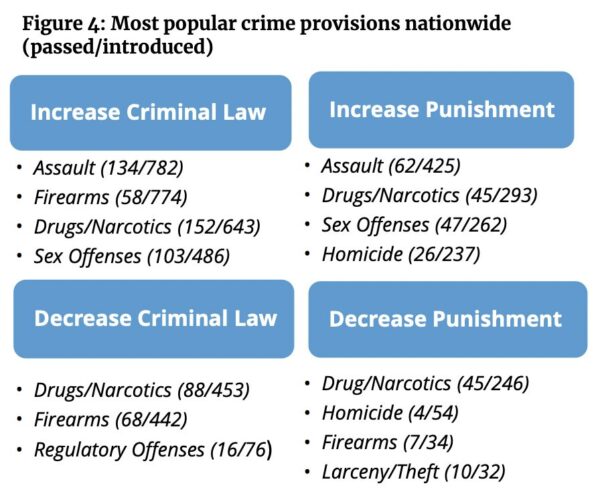
Nationally, state legislatures passed 1,257 out of 7,068 provisions that increased the scope of the criminal law, 435 out of 1,957 provisions that decreased the scope of the criminal law, 524 out of 3,181 provisions that increased punishment, and 201 out of 976 provisions that decreased punishment. Combined, legislatures introduced 10,249 punitive provisions, 3.5 times more than the 2,933 lenient provisions introduced. They passed 1,781 punitive provisions, 2.8 times more than the 636 lenient provisions passed [see image above].

Notably, although the states passed a considerably larger number of punitive provisions than lenient provisions, lenient provisions had a higher passage rate. Lenient provisions changing the scope of the criminal law passed at a rate of 22%, as compared to 18% for punitive provisions. And lenient provisions changing the scope of punishment passed at a rate of 21%, as compared to 16% for punitive provisions.

The report includes a state-by-state breakdown of introduction and passage of punitive and lenient bills. I’ve taken a look at the numbers for California, and it looks like we’re hovering somewhere in the middle, though we made it to #9 in pure lenient bills passed (the gaps are not huge between states, and as you know, in referendum-based systems such as our voter initiative process, bills often include a hodgepodge of provisions, though they usually lend themselves to a classification as “punitive” or “lenient” because they are funded by politically partisan actors).

The report actually addresses this:

When analyzed by number of bills, rather than by number of provisions, it becomes clear that the success of lenient provisions came mostly through the passage of mixed bills—that is, bills that contained both punitive and lenient provisions—rather than the passage of purely lenient bills. Overall, mixed bills were more likely to pass in every offense category, suggesting that these bills may represent important opportunities for legislative compromise that have a higher rate of success. However, even though mixed bills pass at a much higher rate, there are far fewer such bills than purely punitive or purely lenient bills. Consequently, a smaller number of mixed bills are passed.

Because the report covers the years 2015-2018, it reflects the fading attraction of the postrecession bipartisan reforms that I flagged in Cheap on Crime. By then, political polarization came to replace the early-Obama-era collaborations (remember those days, when the ACLU and the Koch Brothers were on board with sentencing reform?) and, as we know, it’s much easier to ratchet sentences up and add criminal offenses than to bring them down and decriminalize.

As to what kinds of bills are introduced, it’s no big surprise that sex offenses continue to be a favorite target for punitive bills. Serious crimes do not tend to trigger lenient legislative sentiments: note that only 4 proposals out of 54 to alleviate punishment for homicide have passed, compared to the rate of success in decreasing criminalization and punishment for drugs, theft, regulatory offenses, and even firearms offenses.

In Governing Through Crime, Jonathan Simon wrote that no politician, of any stripe, wants to be perceived as soft on crime, and the report indeed shows that the state governance (Republican or Democrat) does not usually predict what sort of bills will pass and which offenses are to be targeted:

For crimes relating to abortion and voting & elections, we expected to see more punitive bills introduced and passed in Republican-controlled legislatures. That is what we found.

For crimes relating to pornography & obscenity, we expected to see more punitive bills introduced and passed in Republican-controlled legislatures. But that is not what we found. Republican and Democratic-controlled legislatures passed laws increasing crimes at almost the same rate and Democratic-controlled legislatures passed laws increasing punishment at a higher rate than Republican-controlled legislatures.

For crimes relating to animal cruelty and domestic violence, we expected to see more punitive bills introduced and passed in Democratic-controlled legislatures. But that is not what we found. The number of bills introduced and passed in Republican-controlled and Democratic-controlled legislatures was nearly identical.

For crimes related to hate crimes and regulatory crimes, we expected to see more punitive bills introduced and passed in Democratic-controlled legislatures. But that is not what we found. Indeed, for regulatory crimes, we observed more bills introduced and passed in Republican-controlled legislatures.

For firearms-related laws, we expected to see more bills introduced and passed in Democratic-controlled legislatures that increased criminal law and punishment. We expected to see more bills decreasing criminal law and punishment introduced and passed in Republican-controlled legislatures. But our findings were mixed. We found more bills that increased criminal law introduced (but not passed) in Republican-controlled legislatures; and we found more bills that increased criminal punishment both introduced and passed in Republican-controlled legislatures as well. Our expectations were, however, borne out for bills going the other direction. Republican-controlled legislatures were much more likely to introduce and pass legislation that narrowed the scope of criminal law relating to firearms, and somewhat more likely to introduce and pass legislation that reduced punishment for those crimes.

I think this report provides a rather nuanced perspective on how punitive and lenient legislation operates, and goes against the grain of some of the crude generalizations made on both sides in the media.

Age Is the Most Important Predictor of Risk

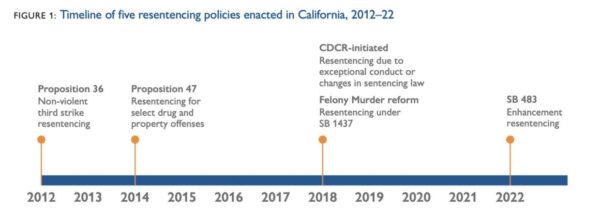
CalMatters, whose reporting on California prisons has been superb in the last few years, have a new article out by Cayla Mihalovich, which takes a look at the recent California effort to decarcerate and looks at who has been released. The article is based on a new report by Alissa Skog and Johanna Lacoe on behalf of the Committee to Reform the Penal Code, which you can read here in its entirety. The report finds that, in the last 15 years, 9,500 people have been released due to these policies:

The main findings of the report are:

Together, these five resentencing policies contributed to the release of
approximately 9,500 people
. The number of people released under each
policy ranged from approximately 800 (CDCR-initiated resentencing) to nearly
5,000 (Prop 47) — with many people, especially those serving long sentences,
released earlier than they otherwise would have been.

People released due to resentencing policies were less likely to be
convicted of new crimes within the first year than total releases, and
the majority of new convictions were for misdemeanors.
The one-year
new conviction rates ranged from 3% (felony murder reform) to 29% (Prop
47). New serious or violent felony convictions were rare, with Prop 47 having
the highest rate at 1.6%.

People resentenced and released after serving long sentences (a
median of 12–16 years) had very low recidivism rates.
Among those
resentenced under felony murder reform, Prop 36, or CDCR-initiated
resentencing, just 3% to 8% were convicted of any new offense within one
year. Fewer than one percent — less than five people — released through
CDCR-initiated resentencing or felony murder reform were convicted of a
serious or violent felony in that time.

Within three years following release, 25% of those resentenced under
Prop 36 were convicted of a new offense
. More than half of those
convictions were for misdemeanors.

Among those resentenced under Prop 47, 57% were convicted of a
new offense within three years, compared to 42% of total releases.

Thirty-eight percent were convicted of a new misdemeanor and 19% were
convicted of a new felony.

Women made up a larger share of people resentenced under felony
murder reform than any other policy.
Felony murder laws hold people
liable for deaths occurring during the commission of a felony, even if they
did not directly cause or intend the death. Women made up 11% of those
resentenced and released under felony murder reform, compared to 7% of
total releases. In contrast, women represented less than 2% of releases under
Prop 36 and SB 483, reflecting gender differences in arrests and convictions for
serious or violent felonies and sentencing enhancements.

People resentenced under these policies were generally older and had
served longer sentences
than all people released from prison in fiscal
year 2018–19 (“total releases”). Nearly 60% were aged 40 or older at
release, compared to 34% of total releases.

Mihalovich, who also read the report, gets straight to the point:

The report found low recidivism rates among people who were older and had served lengthy sentences. Those patterns contrasted with people serving shorter prison sentences for nonviolent crimes, which showed higher rates of recidivism, the majority of which were for misdemeanors. 

The report, as well as my work on Yesterday’s Monsters, FESTER, and the many articles I wrote in between, have persuaded me of something that is plainly evident from the data but for some reason does not get nearly enough attention in criminological research: for all the focus on race, ethnicity, gender, sexuality, etc., the factor that matters the most, by far, to (1) prison conditions (2) recidivism (3) quality of life (4) impact of prison conditions on healthcare outside prison is age. It is alarming to consider that, by 2030, one in three (!!!) prisoners in California will be over the age of 55. Through years of focusing our attention on releasing younger people serving short sentences for nonviolent crimes (which do not necessarily reflect the person’s actual criminal activity), we have turned our prisons into geriatric facilities. The number one surprising fact that my students always share after visiting people in prison is “how old everyone is.” Age is also the one factor that has been robustly found, throughout decades of research in life course criminology, to predict crime rates.

Despite how obvious this is from the data, I don’t think this crucial fact is known or properly appreciated by the public. Moreover, it is not appreciated even within CDCR, which has the most experience dealing with people of various ages. Any parole agent will tell you (and several said so in places where I did fieldwork for YM) that the easiest, most level-headed, calming, and most sensible people they deal with are released lifers who, by nature of their crime of commitment, have spent long years behind bars and are thus in their fifties and over. But when CDCR initiates resentencing, as the report shows, they are shy to release members of this group. Their own risk assessment tool defies what they see and experience every day from these prisoners: they accord disproportionate weight to the crime of commitment, even if that crime happened decades ago. Even when age impacts not just propensity to reoffend, but also serious risk of sickness, hospitalization, and death–such as in the COVID-19 years–the release policies do not prioritize the 55-and-over group. And even though the chief expense on incarcerated people is their healthcare, it does not fully dawn on us that the group with the most expensive healthcare and the least risk should be first in line for releases. The one exception, as the report shows, is the fiscal year 2018-2019, and it is shocking to me that this did not continue in 2020-2021, when this policy would make the most sense.

A related inconvenient truth is that Prop 47, which is loudly decried and loudly defended by opposing political camps, ended up not being the wisest investment from a recidivism standpoint. As I explained in Cheap on Crime, the postrecession renaissance for justice reinvestment, which led to the reversal of the mass incarceration trend for the first time in 37 years, had to rely in many states on bipartisan agreements, and it was easier to agree on low-hanging fruit: nonviolent drug offenders, then perceived as the group to whom our incarceration policies were most unfair. In California, where bipartisan support was not necessary, there was nevertheless a focus on this group because its incarceration tends to be associated with racial discrimination. But the numbers speak very clearly: younger people convicted of nonserious offenses are more likely to recidivate than older people convicted of serious offenses long ago.

Obviously, there are other factors beside risk that go into the sentencing calculus. Serious, violent, even heinous, crimes evoke an understandable public outcry and, for people who believe that punishment should reflect the severity of the offense and serve a retributive purpose, reluctance to release older people serving long sentences is a function of wanting these long sentences to reflect our moral recoil from homicide, rape, kidnapping, etc. But given how long these sentences are–the average person now spends 28 years in prison before being paroled, and this data point is misleading because it includes people who have not yet been paroled–we have to ask ourselves whether or not we believe in atonement at all.

And if the most “bang for our buck” involves the utilitarian function of punishment–reducing the propensity to reoffend, whether through deterrence or rehabilitation–age is and should be a factor. People in their fifties, sixties, seventies, and eighties do not recidivate not because they’ve been “scared straight” or because they’ve “reformed” but because they have simply aged out of crime. This is a politics-neutral fact that we have to accept and must make the cornerstone of our resentencing/release/parole policies.

Defendant’s Right to Testify… Whenever? Also: TikTok Jurors

I just caught up with the denial of Donna Adelson’s motion for a new trial. The defense brought up numerous claims, the most interesting of which were jury contamination and a violation of the defendant’s right to decide whether to testify or not. Let’s tackle the latter one first. You can see for yourself how things went down as the defense wrapped up its case:

When watching the trial live, I empathized with the judge’s impatience, but worried that he might not be cautious enough to avoid being reversed on appeal. I’ve now caught up with some commentary about the trial, including this excellent analysis by Peter Tragos:

The transcript of the sidebar conversations, as well as the colloquy Judge Everett had with the parties the morning after the defense rested, have reassured me that the defendant really got all the possible leeway and opportunities to make an informed decision whether to testify. Thank you, Mr. Tragos!

But this brings up a different issue: how do we feel about the defendant testifying last at their trial?

The idea that the defense has the freedom to fashion trial strategy as they see fit is a cornerstone of criminal defense, but in other countries there are special rules about testimony. In Israel, and I bet in other former British colonies as well, the rule is that the defendant must testify first. This makes a lot of sense: the defendant is the witness that has the most at stake, and they are also the only witness who actually gets to sit in court for the entire trial (all other witnesses may not sit in court when their fellow witnesses are testifying, and the Adelson defense was scolded about this at least twice). This, to me, raises the obvious implication that a defendant who testifies after the other witnesses can make strategic decisions. In fact, it’s so obvious that commenting on it to the jurors is not considered a violation of the defendant’s right to testify. In Portuondo v. Agard (2000), the prosecutor stated the obvious in closing argument:

You know, ladies and gentlemen, unlike all the other witnesses in this case the defendant has a benefit and the benefit that he has, unlike all the other witnesses, is he gets to sit here and listen to the testimony of all the other witnesses before he testifies.

That gives you a big advantage, doesn’t it. You get to sit here and think what am I going to say and how am I going to say it? How am I going to fit it into the evidence?

He’s a smart man. I never said he was stupid ….

He used everything to his advantage.

The Supreme Court found that these words did not unlawfully infringe on the defendant’s right to testify:

[W]e see no reason to depart from the practice of treating testifying defendants the same as other witnesses. A witness’s ability to hear prior testimony and to tailor his account accordingly, and the threat that ability presents to the integrity of the trial, are no different when it is the defendant doing the listening. Allowing comment upon the fact that a defendant’s presence in the courtroom provides him a unique opportunity to tailor his testimony is appropriate-and indeed, given the inability to sequester the defendant, sometimes essential-to the central function of the trial, which is to discover the truth.

If we, too, had a procedural rule that the defendant must testify first, we would do away with the need for such warnings and would also curb the strategic/manipulative potential of having the defendant hear other witnesses.

Now, let’s turn to the TikTok issue. I agree with Tragos (seriously, listen to the entire thing – he does a great job pulling relevant sections from the transcript!) that the judge’s instructions to the jury allowed them to share the fact that they were on jury duty with “anyone who needs to know where you are,” and that he also told the jury not to disclose any information about the case itself. But I have to ask myself what drives a person who heard these warnings to make a TikTok about the general experience, albeit not mentioning the case, after being impaneled. Come on, people. You are indeed living your life even if you’re not reporting every second of it on social media. I don’t think this will lead to a reversal on appeal, but for heaven’s sake, why take the risk?

FESTER Wins ASC Book Award

Friends, I’m thrilled (and quite surprised and shocked) to share with you the good news that our book FESTER: Carceral Permeability and California’s COVID-19 Correctional Disaster has won the American Society of Criminology Michael J. Hindelang Book Award for 2025! 

This is a huge and rare honor, and one we did not expect in our wildest dreams, even though we deeply believed in our project and knew the book was good. We didn’t write it to win awards or attend fancy plenaries, but to bear witness to California’s worst-ever medical prison scandal and sound the alarm about prison conditions that allow disease and suffering to fester. We wrote it from the bottom of our wrenched hearts and it spoke to the awards committee from the same heartfelt place.

The story of FESTER is, first and foremost, your story: the story of incarcerated and formerly incarcerated people, families, activists, advocates, lawyers, doctors, journalists, psychiatrists, psychologists, statisticians, epidemiologists, volunteers, and other upstanding citizens who came together to sound the alarm on behalf of the most neglected people in the state when your voice mattered the most–and when the government turned its back on our most vulnerable friends and neighbors in their most dire hour of need. Our hope is that this award will help FESTER contribute, even a little, to an urgent conversation about how to improve prison and jail conditions that will prevent the horror we lived through from happening ever again.

You followed this story in real time: this blog documented what we learned every day from our friends and neighbors about the neglect, ineptitude, rumor mongering, and devaluing of human lives they suffered. You were the first to have access to our raw data and to read our blow-by-blow account of the state and federal litigation. And when the time came to speak up, many of you stood with us and with our neighbors behind bars, reminding the rest of our state–and the government–that, in the context of health crises, there is no “other”.

Our book is your book. Our story is your story. Our award is your award. And our struggle is your struggle.

No Good Parts

I’m writing this as I’m digesting the news: Donna Adelson was found guilty of murdering my friend and colleague Dan Markel. She joins four other people convicted as part of this case: Sigfredo Garcia and Luis Rivera, the murderers for hire; Katie Magbanua, the intermediary; Charlie Adelson, Danny’s brother in law, and the action man in procuring the hit; and now Donna. Two members of the Adelson family remain uncharged in this matter: Wendi, Danny’s ex-wife, whose contentious divorce proceedings made Danny the target of the Adelson family.

I won’t rehash the facts of the case–they have been widely reported in the media and you can look them up. What’s interesting to me, though, is what this case suggests in terms of the limits of our theory of criminal accountability.

Let’s take the prosecution’s closing argument:

At this point, only Donna is on trial, and therefore the prosecutor, Georgia Cappleman, has to highlight the parts that involve her, specifically. But you’ll see that much of the closing argument revolves around Charlie and his part in the crime. It’s impossible to talk about Donna’s part in isolation from the role played by everyone else, even as criminal law requires doing so because we only convict individuals on the basis of their individual actions and mental states.

Throughout the day, as I was following the arguments in real time, I was worried that this closing would backfire and that the jury would be concerned that not every aspect of this horrific crime can be traced back, and attributed, to Donna. But it looks like the jurors intuitively understood what I was thinking about the whole time: it is impossible to understand this crime without understanding the dynamics in the Adelson family.

Family Systems Theory is a therapeutic approach in which the unit of analysis is not the individual, but rather the family. The behaviors, communication patterns, thoughts, and emotions of the family members are interconnected. Some patterns are lateral and some are intergenerational, but no individual stands on their own; there is always a tension between a person’s individual identity and emotional autonomy and how the person operates as part of a web of family relationships.

From a family systems perspective, the roles and patterns among the Adelsons are set and calcified: Harvey is the silent, passive partner. Donna is the mover and shaker. Charlie is the dependable action man. And Wendi is the fragile child who needs protection. Without understanding this division of labor, it’s impossible to fathom why Donna was so involved in Wendi’s life, to the point of picking guys to date for her and impersonating her at the bank; why the three “adults” volunteered to bribe Danny to allow Wendi to relocate in three equal parts, without Wendi, an adult mother of two children, chiming in; why mother and son have conversations about how to deal with a possible blackmailer and do not involve daughter and father.

There’s a book by Richard Schwartz called No Bad Parts, whose main thesis imports the notion of family systems into understanding the individuals. Schwartz posits that we are all born with “sub-minds–or parts” and that “[t]hese parts are not imaginary or symbolic. They are individuals who exist as an internal family within us.” Schwartz even provides a typology of these parts: Managers (protective parts that try to control our environment), Firefighters (reactive parts that emerge in crisis), and Exiles (wounded parts that carry our pain and trauma). None of these is inherently “bad”; they all develop for protective reasons and deserve understanding and their own place under the governance of the self.

Viewing the Adelson family through this lens sees the archetypes as occupying parts in protecting and contributing to a dysfunctional, monstrous collective – if you will, no good parts. Even as some family members end up convicted and others acquitted, the legal analysis fails to capture the picture because its unit of analysis is too small.