

Colleagues at UNC School of Law’s Prosecutors and Politics Project have shared an important report that analyzes legislation proposed and enacted in all 50 states between the years 2015 and 2018. It’s a telling bracket, because it features two years of a Democratic presidency and two of a Republican presidency, and the study looks, of course, at a variety of states, with varying red, blue, and purple political orientations. The findings are quite universal and defy political divisions:
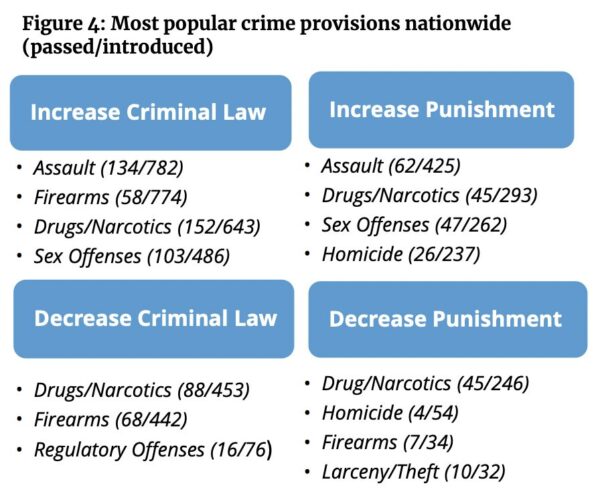
Nationally, state legislatures passed 1,257 out of 7,068 provisions that increased the scope of the criminal law, 435 out of 1,957 provisions that decreased the scope of the criminal law, 524 out of 3,181 provisions that increased punishment, and 201 out of 976 provisions that decreased punishment. Combined, legislatures introduced 10,249 punitive provisions, 3.5 times more than the 2,933 lenient provisions introduced. They passed 1,781 punitive provisions, 2.8 times more than the 636 lenient provisions passed [see image above].
Notably, although the states passed a considerably larger number of punitive provisions than lenient provisions, lenient provisions had a higher passage rate. Lenient provisions changing the scope of the criminal law passed at a rate of 22%, as compared to 18% for punitive provisions. And lenient provisions changing the scope of punishment passed at a rate of 21%, as compared to 16% for punitive provisions.
The report includes a state-by-state breakdown of introduction and passage of punitive and lenient bills. I’ve taken a look at the numbers for California, and it looks like we’re hovering somewhere in the middle, though we made it to #9 in pure lenient bills passed (the gaps are not huge between states, and as you know, in referendum-based systems such as our voter initiative process, bills often include a hodgepodge of provisions, though they usually lend themselves to a classification as “punitive” or “lenient” because they are funded by politically partisan actors).
The report actually addresses this:
When analyzed by number of bills, rather than by number of provisions, it becomes clear that the success of lenient provisions came mostly through the passage of mixed bills—that is, bills that contained both punitive and lenient provisions—rather than the passage of purely lenient bills. Overall, mixed bills were more likely to pass in every offense category, suggesting that these bills may represent important opportunities for legislative compromise that have a higher rate of success. However, even though mixed bills pass at a much higher rate, there are far fewer such bills than purely punitive or purely lenient bills. Consequently, a smaller number of mixed bills are passed.
Because the report covers the years 2015-2018, it reflects the fading attraction of the postrecession bipartisan reforms that I flagged in Cheap on Crime. By then, political polarization came to replace the early-Obama-era collaborations (remember those days, when the ACLU and the Koch Brothers were on board with sentencing reform?) and, as we know, it’s much easier to ratchet sentences up and add criminal offenses than to bring them down and decriminalize.
As to what kinds of bills are introduced, it’s no big surprise that sex offenses continue to be a favorite target for punitive bills. Serious crimes do not tend to trigger lenient legislative sentiments: note that only 4 proposals out of 54 to alleviate punishment for homicide have passed, compared to the rate of success in decreasing criminalization and punishment for drugs, theft, regulatory offenses, and even firearms offenses.
In Governing Through Crime, Jonathan Simon wrote that no politician, of any stripe, wants to be perceived as soft on crime, and the report indeed shows that the state governance (Republican or Democrat) does not usually predict what sort of bills will pass and which offenses are to be targeted:
For crimes relating to abortion and voting & elections, we expected to see more punitive bills introduced and passed in Republican-controlled legislatures. That is what we found.
For crimes relating to pornography & obscenity, we expected to see more punitive bills introduced and passed in Republican-controlled legislatures. But that is not what we found. Republican and Democratic-controlled legislatures passed laws increasing crimes at almost the same rate and Democratic-controlled legislatures passed laws increasing punishment at a higher rate than Republican-controlled legislatures.
For crimes relating to animal cruelty and domestic violence, we expected to see more punitive bills introduced and passed in Democratic-controlled legislatures. But that is not what we found. The number of bills introduced and passed in Republican-controlled and Democratic-controlled legislatures was nearly identical.
For crimes related to hate crimes and regulatory crimes, we expected to see more punitive bills introduced and passed in Democratic-controlled legislatures. But that is not what we found. Indeed, for regulatory crimes, we observed more bills introduced and passed in Republican-controlled legislatures.
For firearms-related laws, we expected to see more bills introduced and passed in Democratic-controlled legislatures that increased criminal law and punishment. We expected to see more bills decreasing criminal law and punishment introduced and passed in Republican-controlled legislatures. But our findings were mixed. We found more bills that increased criminal law introduced (but not passed) in Republican-controlled legislatures; and we found more bills that increased criminal punishment both introduced and passed in Republican-controlled legislatures as well. Our expectations were, however, borne out for bills going the other direction. Republican-controlled legislatures were much more likely to introduce and pass legislation that narrowed the scope of criminal law relating to firearms, and somewhat more likely to introduce and pass legislation that reduced punishment for those crimes.
I think this report provides a rather nuanced perspective on how punitive and lenient legislation operates, and goes against the grain of some of the crude generalizations made on both sides in the media.


No comment yet, add your voice below!