News! FESTER Available for Preorder

Fester Book Cover

We’re live! FESTER, my book with Chad Goerzen about the COVID-19 catastrophe in California prisons and jails, is available for preorder on the UC Press website and on Amazon. The official publication date is March 2024.

From the back jacket:

The mismanagement of the COVID-19 pandemic in California’s prisons stands out as the state’s worst-ever medical catastrophe in a carceral setting. In Fester, socio-legal scholar Hadar Aviram and data scientist Chad Goerzen offer a cultural history of the COVID-19 correctional disaster through hundreds of first-person accounts, months of courtroom observations, years of carefully collected quantitative data, and a wealth of policy documents. Bearing witness to the immense suffering wrought on people behind bars through dehumanization, fear, and ignorance, Fester explains how the carceral system’s cruelty threatens the health and well-being not only of those caught in its grasp, but all Californians—and stands as a monument to the brave coalition of incarcerated and formerly incarcerated people, family members and loved ones, advocates and activists, doctors, journalists, and lawyers who fought to shed light on one of the Golden State’s correctional system’s darkest times.

If you’d like us to come to your campus or bookstore in Spring 2024 and beyond, please contact us and we’ll make it happen.

I Was Right About Recession-Era Decarceration: Population Has Decreased and So Have Racial Disparities

It’s always complicated to write what David Garland calls a “history of the present“, especially in criminal justice, where trends can become visible only years after the fact. And yet, that’s what I tried to do in Cheap on Crime, which was published in early 2015 but completed in 2013. The impetus for the book was the change in direction in incarceration rates: 2009 was the first year in 37 years that saw a decline in incarceration rates. I thought that was important, and observed that the change in direction was accompanied by a host of policies and rhetorics that focused on “justice reinvestment” and trimming the expensive correctional apparatus in the aftermath of the 2008 financial crisis.

The book was well received and won a nice award, but some folks in the discipline found it too optimistic. It didn’t fit in neatly with the pessimistic slant of the discipline as a whole, where we can critique mass incarceration (especially, though not exclusively, from a racial standpoint) by showing that things are progressively getting worse, not better. At one of my book events in 2015 I said that I worried that our love for critiques of neoliberalism might be leading us to ignore the data, or at least to pretzel ourselves with complicated rationalizations for why an incarceration picture that seems to be getting better is actually getting worse. Or something.

Last week, the Sentencing Project published an interesting report looking at incarceration trends from the recession–the peak incarceration year–to 2023, and the picture is quite encouraging. The report, titled One in Five: Ending Racial Iniquities in Incarceration shows the still-extant racial disparities within prison and jail populations and, of course, emphasizes these in the title, but does not shy away from providing important descriptive data showing that, not only is the decline in prison and jail populations the mirror image of the rise that preceded the Great Recession, but it is also accompanied by a significant decline in racial disparities. Here are some of the highlights.

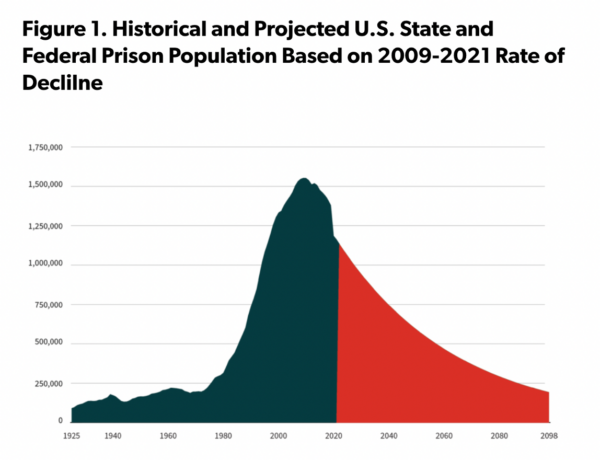
First, there’s this. It might be optimistic, but it does predict the decline in prison population based on the current rate of decline. In other words, if the trends set during the recession continue, we might be heading to pre-1970 incarceration rates. This is fanciful, and things can change for the worse the way they did in the 1970s, but we can dream.

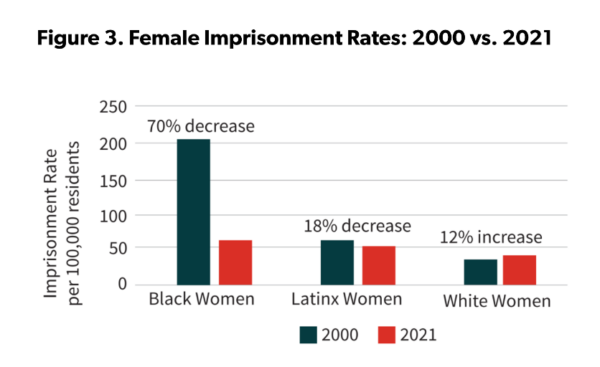
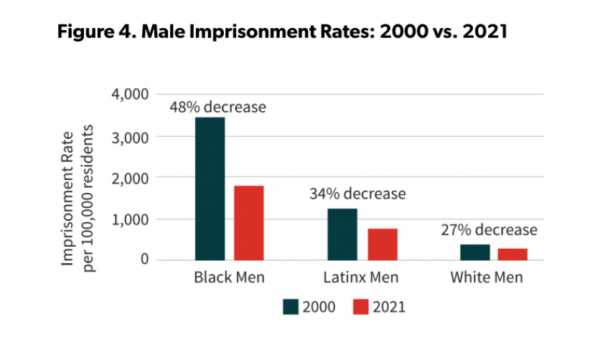
Let’s leave conjecture behind and talk about facts. Here are the declines in prison populations by race. As you can see, decarceration across the board is mitigating the disparate racial effects that characterized the incarceration boom:

The effect is most pronounced for women, but it is significant for men as well:

And similar, though not identical, trends are present for county jail populations:

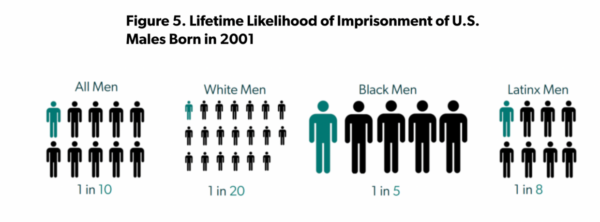
Lest you think that all is well with the world, we’re still seeing big sentencing disparities. 1 in 5 Black men (compared with 1 in 8 Latino men and 1 in 20 White men) born in 2001 is likely to be incarcerated at least once in his lifetime.

There is still plenty of work to do until we can look at a graph that looks like the conjecture above and congratulated ourselves. But things are definitely looking up, significantly so, and it’s okay to point out positive developments when they happen rather than try and come up with stories with why they are actually negative. Or something. And while I’m pleased to have been right, I’m even more pleased to see that, at least in this area, we’re on the right path.

If You Are Cheering Or Rationalizing a Pogrom, I’m Done With You: An Open Letter to My Colleagues

It’s not news to me that my line of work is an antisemitic Petri dish. For a profession full of folks of Jewish descent, it delivers plentiful opportunities to realize how alienating and silencing the progressive conversation in the field is to Jews and especially to Israeli Jews. This stuff often masquerades as anti-Israelism or anti-Zionism, but it looks, walks and quacks like what it is. My entire career in the United States, starting with the first year at Berkeley as a grad student, was suffused with antisemitism. In 2001, fresh in the United States for grad school, I rode a bus from campus to my home, and Students for Justice in Palestine took over it and shook it. The whole bus. They took over the Wheeler building. On Holocaust Day.

That same year we brought in a new roommate from Taiwan – a PhD student – who was surprised that my nose wasn’t bigger and that I didn’t look like the people from Fiddler on the Roof.

A few months before I took my current job, in 2007, someone who would be my colleague for over a decade published an op-ed calling to expand the boycott of Israeli academics to the United States. That colleague was later asked by the person in charge of my tenure file to sit in my class and write a report of my pedagogy for the file. I was the one who had to go to that person and, politely smiling and with a friendly tone, advise him to be more cautious as they could end up with lawsuits on their hands due to carelessness. “You people are so political all the time,” was the response.

Students whom I taught using diagrams from a human rights report from B’Tzelem about outrageous torture in interrogations of Palestinians contacted the dean and the chair of my tenure committee, lying that I “trivialized Palestinian suffering with a cartoon.”

My first, award-winning book Cheap on Crime, which has nothing to do with Judaism or Israel, has lots of excellent reviews on Amazon… and one bad review. The bad review, written by a man who doesn’t know me or my opinions about Israeli politics and has not read the book–he saw an ad for a talk I gave, which had a short bio of mine–is titled “Israeli militarist on the loose.”

I’ve had to sit through countless panels in which anyone cheering Palestinian terror is met with snapped fingers and applause.

I’ve had a law review editor ask me to excise my military service from my CV, so that his friends might agree to publish my paper.

I’ve had to listen to people with graduate degrees and publications espouse ignorant, sophomoric opinions about a conflict on which they have no expertise, that were drilled into them, using the right vocabulary and getting the right nods.

I’ve seen colleagues who are Jewish authoring earnest op-eds extolling the virtues of rude and violent students to make their campuses inhospitable for their Jewish and Israeli colleagues.

I’ve had to endure idiotic explanations by fashionable anti-Zionists, many of them Jewish, who have no idea what Zionism is, are utterly unacquainted with its many strains, and cannot name a single Zionist philosopher or thinker.

I’ve had to sit through a hiring meeting and listen to a colleague who insisted that we have no one on the faculty from the Middle East. When a colleague and I said that we were from the Middle East, she explained that she meant “real Middle Easterners.”

I’ve seen people paint Israel with a broad brush stroke, as if there aren’t millions of Israelis, me included, fighting against the occupation and against the Netanyahu government. As if my friends aren’t protecting Palestinian farmers against armed settlers. As if it is impossible to believe that Jews must have a safe place on Earth and at the same time work for the human rights of Palestinians.

But today I’ve seen colleagues sink to a new low. One published an antisemitic caricature that would not be out of place in Der Stirmer (the message was that Israel is pretending to be a victim while being the aggressor. What?) Another unabashedly is advertising an event on “Palestinian resistance” in the Law & Society group. I wrote back. She doubled down, as she’s promoting her book. I would name names, but why? You know exactly who you are and you’re not ashamed of it, apparently, because you know enough of your professional connections will cheer you on. People have made very successful careers in this field out of being shameless. I doubt that this post will earn me anywhere near that acclaim, but if that means not being invited to have coffee with antisemites at a conference, I can live with the deprivation.

I shouldn’t have to explain why this is appalling, but for those who have managed to avoid the pictures of sobbing hostages, kibbutzim burned to the ground, and terrorists celebrating and throwing candy as they mangle their victims’ naked bodies, here’s my friend Tal Guttman:

For all of my non-Israeli friends, who might think this is another round of tango between Israel and the Hamas: This is much closer to 9/11 than anything we have experienced here in Israel in the last 40 or 50 years. This was an invasion. Hamas terrorists went house to house, murdering children in front of their parents, abducting 70 year old grandmothers and 12 year old schoolchildren to Gaza. 260 people were butchered in a rave. The coverage in official news channels focuses on the big buildings going down in Gaza, but I urge you to go to twitter and read the (translated if needed) testimonials, sometimes live, of people who are tweeting from their safe rooms as the terrorists are outside, telling their kids it will be all right.

Imagine that in 9/11, terrorists would invade the US, shoot 33,000 (1000) civilians dead, wound 60,000 (2000), and abduct 3000 (100) American citizens, and held them hostage in Afghanistan. Adjusting for country size, this is what happened in Israel yesterday. This is going to lead to a long, and painful war. It breaks my heart.

I despise Netanyahu, and believe his current coalition of alt-right jewish supremacist firestarters is the worst in the history of the nation and the biggest threat to Israel’s existence. However, I hear people saying how the attack yesterday was a result of recent Israeli provocation. A coordinated, large scale and surprise attack of this kind takes months to prepare and train for. This was pre-meditated, pre planned. The Israeli provocations were only an excuse. This is what pure evil looks like.

Today I’m done with professional hypocrisy, with sitting quietly in rooms where unbelievable things come out of people’s mouths. I will leave conversations that deny my humanity, respond publicly on mailing lists to people whom I emailed privately before so as not to shame them. I will not shrug off situations that evince an astonishing level of cultural and academic gaslighting. If you have ill-informed opinions that celebrate or rationalize pogroms, that explain away rape and murder of children, women, and elderly people as “resistance”, or espouse some nonsense that tries to graft this conflict onto your parochial perspectives on race in America, I am officially done with you in any professional and personal capacity. If you cannot tell the difference between resistance and mass atrocity, your humanity is so compromised that I don’t know where to even begin to educate you. Nor would you be interested in being educated.

In the days to come, this will naturally become muddied. This war will claim civilian casualties on both sides, air strikes are already devastating Gaza, and none of this is bringing the hostages any closer to home. The villains on both sides will capitalize on it. And as we all know, the more morally questionable the retaliation, the more antisemitism will flourish online. A lot of this critique will be understandable and much of it will be justifiable. But it’s telling that the backlash started *before* the retaliation, which has exposed people’s true colors.

I honestly don’t know where to go from here in this line of work. I have zero motivation or desire to work or interact with anyone whose moral compass is so compromised, and these opinions are so entrenched in my profession that I doubt I can find an environment where I feel like I can breathe. The alternative is to go back home, to a country so degraded by Jewish religious messianism and so at risk from Muslim religious messianism that I can’t in good conscience raise my son there. Our great Yiddish authors called it: there’s nowhere for Jews to put their heads down.

Murderous Hamas Attack on Israel: How to Help

On October 7, Hamas terrorists launched a large-scale murderous invasion of Israel from the Gaza Strip, slaughtering at least 700 Israelis, injuring thousands, and taking at least 100 people–women, children, elderly folks–hostage. I am beside myself with horror and in constant touch with my family.

No explainers, as this is unfathomable, nor should you trust anyone already dispensing hot takes. Actual combat is still very much taking place in the streets.

Here’s how you can help (and thank you):

Unxeptable have a linktree with information and resources, and they have also provided verified links for financial assistance. You can also volunteer to host Israelis who have been stranded abroad due to flight cancelations. Click here if you need a place to stay.

The protest organizations in Israel are collecting funds for all affected communities here.

Israel Trauma Coalition will need all the funds they can get to help build resilience for the many thousands of affected families.

Kibbutz Nir Oz underwent a horrible massacre. Dozens were murdered or kidnapped in front of their families, and homes were burned. They can use your help.

Please do not share horror pictures and videos on social media, even for supposedly constructive ends such as “educating” or “raising consciousness.” I should not have to explain why not.

Please do not get pulled into political arguments on social media and comments sections. You are likely wasting your time and exhausting your precious energy arguing with hostile bots.

If you need an uplifting community experience, numerous Jewish congregations are holding special services that can help your morale and make you feel less alone (such as the one I attended this morning at Temple Emanu-El, depicted above). These events are held with heavy police security for obvious reasons.

Stay safe, watchful, and proactive.

Film Review: 26.2 to Life

I still remember the incredible emotions that choked me as I took the last steps of the Oakland Marathon and realized that, yes, I was going to finish. Even with lots of experience racing endurance events, including some very long marathon swim, there was nothing quite like it. And the faces of everyone around me reflected that we had all undergone a very special experience, stretching body, mind and spirit to their limits, and that we would forever share that experience.

It is this direct appeal to common humanity that drives Christine Yoo’s fantastic documentary 26.2 to Life, which is now playing in select theaters and winning all sorts of incredible awards at film festival. With unparalleled access to the inside of San Quentin–the yard, of course, 105 laps of which add up to 26.2 miles, but also other areas of the prison, including the cells–this documentary has the potential to go where no work of advocacy has gone before.

Lots of tired, jargony academic pieces about carceral geography and mass incarceration blather about “bodies” and “embodiment”, but nowhere is the somatic experience of an incarcerated body more visceral than in this film. We see people living under the horrid conditions that are only too familiar to regular readers of this blog and using endurance running–their own bodies, pushed to their limit–to sublimate and divert anger, to release stress, to find liberation, to imagine commonalities and brotherhood with people running on the outside. In one memorable scene, runner Jonathan Levin talks of running as a physical form of doing penance for his crime, reminding me vividly of the incredible ending scene of the Buddhist film Spring, Summer, Fall, Winter… and Spring.

Other runners feature more prominently, and we get to learn their personal stories. Markelle “The Gazelle” Taylor, the fastest runner of the club, dreams of qualifying for the Boston Marathon and running it if he makes parole. Rahsaan “New York” Thomas finds his voice as a journalist and leader in prison (his work for the San Quentin News and for Ear Hustle is also featured in Adamu Chan’s recent documentary What These Walls Cannot Hold. Tommy Wickerd works hard to redeem himself from a life of violence and be as much of a good husband to Marin and father to Tommy II as he can from behind bars. These folks, and many others featured in the film, are people I know. Some of them I met in person, though most of them I did not; I did spend many many hours with their loved ones, and hearing from them, in the weekly #StopSanQuentinOutbreak coalition meetings that we document in FESTER. There was something heartbreaking in watching these very familiar people in footage from before the calamity would strike and terrorize them and require them to develop new forms of courage and work new psychological muscles.

What stands out in the movie is how it lends itself to bridges of empathy and perspective taking. Not pity–though the men’s stories are contextualized in a way that does not absolve them from accountability and yet evinces profound understanding of their circumstances–but the same sense that every one of us has felt upon embarking on a huge athletic undertaking. The same sense of exhilaration and terror that is evident in the first steps of the protagonist of Brittany Runs a Marathon; the same trepidation and enormous effort of the swimmers in Driven; the sense of dread, then relief, accompanying Alex Honnold’s heroic climb of El Capitan in Free Solo. Christine Yoo has elevated Taylor, Thomas, Wickerd and the other runners to their rightful place along these cinematic athletic heroes by bringing her viewers into communion with the most basic things we all share: our bodies and our striving to make something of our lives within them.

You must see this movie. And you also must consider financially helping some of the film’s heroes. As pioneering research by Alessandro de Giorgi shows, the first and foremost challenges for anyone on the outside involve their basic survival: finding a place to live and a job. Even phenomenal athletes are not exempt from this. Markelle sells amazing athletic gear you can wear in pride for your training and racing, and Rahsaan is doing wonderful journalistic work that requires support.. Too often we expect formerly incarcerated folks to hit the ground running with activism for their friends still on the inside, discounting the importance of getting their own lives in order. Let’s lend our fellow athletes a helping hand.

Mendelssohn Reimagined: The Yom Kippur Conflict

The fierce conflict that erupted in Tel Aviv’s Dizengoff Square on Yom Kippur showed how a classic political philosophy problem can come to blows. Religious organization Rosh Yehudi asked the city–seen as the bastion of civil rights and secular progress–for permission to hold an outdoors prayer with segregation between men and women. Municipal authorities refused: Tel Aviv does not hold segregated public events, a creeping problem in many municipalities in Israel. Rosh Yehudi leaders appealed the decision to the Tel Aviv District Court and were rebuffed, and nevertheless mysteriously announced that they have found a way to hold the prayer in a way that “upholds both halakhah and the law.” At the event, this way was unveiled: they did bring screens and dividers, and some of them were armed.

Secular people, angry at Rosh Yehudi’s flouting of the city and court mandates, interrupted the prayer loudly with noise and protest and removed the barriers. For religious people, this was a difficult sight to bear, as Yom Kippur is one of the only bastions of public religiosity that used to be tolerated and protected by the secular majority. Here is footage of the incident:

Video by The Holy Land, by Zahi Shaked

For more on this, you can listen to this interesting podcast, or read the opposing views of Daniela Gan Lerer and Meital Pinto. The incident also splintered the protest movement, as some thought the provocation would be counterproductive while others expressed the awakening of the secular public from decades of religious coercion.

To me, the incident underscored how much the serious issues that philosopher Moshe Mendelssohn raised in his book Jerusalem are still vividly present–and how they arise in Israel in much the same way that they arose in Germany in the late 18th century. Mendelssohn, a bright light of Western philosophy, in conversation with other Enlightenment greats like Lessing, Dohm, and Kant–whom he beat at an essay competition!–lived a life of deep contradiction (read all about his life in Leora Batnitzky’s book How Judaism Became a Religion.) He was an observant Jew who was at the same time versed in fresh Western philosophy; he wrote commentary on the Torah (which would later be banned by ultra-orthodox authorities) as well as hobnobbed with Berlin’s intelligentsia–even as he had to enter the city, where his own living situation was precarious due to his Jewishness, through the animal gate; he presented Judaism, to non-Jews, as a religion of reason, superior to Christianity in terms of its compatibility with science and reason, lauded ideals of the Enlightenment era, while at the same time explaining the importance of the embodied rituals that made Jews seem so alien to, and othered in, their European surroundings.

The advent of the modern state and the earnest focus on equality and civil rights (along with all the glaring blind spots that it had) brought to the forefront what came to be known as “the Jewish Question”: up until then, as my beloved dad described in his wonderful short story collection, Jewish communities lived amongst themselves, not really mixing up much with the general population, not regarded as full citizens, steeling themselves against pogroms and general hostility from the surrounding community, and pretty much self-governed by their own rabbis and authorities. But with new winds of civil rights and citizenship blowing in European countries, mostly in Germany, some thinkers figured that better integration and civil rights should be granted to Jews. For some thinkers, offering citizenship to Jews was important for the improvement of the Jews themselves, who were deemed backward and reviled based on their dress and customs (as well as their financial occupations); but for Mendelssohn, offering citizenship to Jews was important because Judaism should be regarded as a religion–the person’s private business, between them and their religious community–rather than a membership card in a political entity. In other words, one can be Jewish in their own home, following the customs and halakhic directives, and a full-fledged German or French citizen in the public sphere. The difference between religion and state, posited Mendelssohn, was the source of its power:

The state dictates and coerces; religion teaches and persuades. The state enacts laws; religion gives commandments. The state is armed with physical force and makes use of it if need be; the force of religion is love and benevolence.

This was directed especially as a critique of the practice of religious excommunication: Mendelssohn did not want to accord to religious leadership the statelike power of obliterating a person from their membership lists based on their inner faith or beliefs.

What’s remarkable about Mendelssohn’s writings, and his massive influence on the haskalah movement, is that they centered around the question of Jewish citizenship in European countries. The notion that Jews might at some point be citizens in their own nation-state did not come into the conversation. Just a few decades later, when the Hamburg temple would reform its liturgy, one of its main innovations would be prayer in German rather than in Hebrew, under the assumption that Hebrew was a dead language, irrelevant to the lives of the German-speaking congregation. The idea that, one day, Jewish people would congregate in a public place and pray in Hebrew was unimaginable.

The kicker is this: As my late, beloved colleague Gad Barzilai famously wrote in his book Communities and Law, most of the writings on multiculturalism–in many ways, a continuation of the Enlightenment-era debate–are the work of political philosophers examining the adaptation of ethnic and religious groups to largely Western societies in the United States, Canada, and Europe (Waldron, Nozick, Kymlicka, Parekh). Very little of this has engaged with non-Western societies, and particularly with Middle Eastern societies. Which brings us back to the peculiarities and endemic characteristics of the Yom Kippur conflict. One of the main admonitions of the protesters in the public debate about this was that the prayer gathering was deliberately (and provocatively) planned to take place not only in open, public place, but at a bastion of secularity. “If they want to pray with gender segregation,” goes the argument, “they are more than welcome to do so–in their own orthodox synagogues.” This argument, for me, echoes a Mendelssohnian concept of Israel as a European nation-state: the power of the state is secular and secularizing, and religion should be kept as the person’s private business, conducted in their private sphere, and certainly not endorsed by the state apparatus.

Contrast this to the position held by the organizers of the prayer gathering. Their position implies that Israel, unlike the Mendelssohnian state, boasts a unique religion-state nexus through its declaration of independence as a “Jewish and democratic country”, and has a special, privileged position for the Jewish faith that must be respected in the public sphere. The battles along this lines are many and varied, and only recently included the big blow-up over keeping Passover kashrut laws within public hospitals.

It may well be that “Jewish and democratic” are not harmonizable ideas, and that this conflict, along with its other manifestations, has brought to a head the fact that multicultural theories can produce neat analyses (and clearly defined disagreements) only in the situation that Mendelssohn and his intellectual progeny could envision: a seemingly secular state contrasted with religious subgroups. But even this is a bit farcical. The extent to which German society, presumably sterilized from religious contamination, was truly that–with Judaism having the same relationship with it as, say, Christianity–is highly dubious, and we know that many philosophers of the era (even Kant!) explicitly discussed religious elements in their state theories. Could it be that the relationship of religious Jews with their Jewish-and-democratic state is, in some way, analogous not to the relationship of Jews with 18th century Germany, but rather to the sublimated, seemingly invisible relationship of Christians and Christianity with 18th century Germany? If so, what this conflict does is bring to the forefront a sticky problem that permeated not Mendelssohn’s thinking, but the thinking of his contemporaries, who mistook hegemony for secularity and habitus for neutrality.

Good Guys with Guns?

A week ago I was asked to comment on an announcement by the Governor of New Mexico who, reacting to a terrifying rise in gun violence in Albuquerque, issued an executive order that would suspend both open and concealed carry laws in Albuquerque and Bernalillo County, temporarily banning the carrying of guns on public property with certain exceptions. Following quite a bit of backlash from both parties, the Governor then limited the ban to parks and playgrounds.

Because this is not my area of expertise/publication, I quickly consulted with my colleague Prof. Jennifer Carlson, who is one of the nation’s most impressive experts on gun policy. Jennifer agreed with me that, even though the Governor’s action makes sense from both moral and practical stand point, it is not constitutionally defensible, certainly not in this judicial climate, after the Supreme Court’s recent decision in Bruen. Still, it’s worth asking ourselves the question whether, even if the constitution allows us to bear arms, it is a good idea to go ahead and do it.

Recently, the Bureau of Alcohol, Tobacco, Firearms and Explosives released a report on guns, which you can read here in its entirety. This NPR story provides some important takeaways which, in my opinion, all boil down to the same conclusion: anyone thinking that the world of gun ownership can be easily dichotomized into good guys/bad guys or legal/illegal guns is not seeing the full picture.

For one thing, it turns out that more than half of gun crimes utilize lawfully purchased guns. To this number, we must add a million stolen guns which were held in legal hands until recently. Notably, the vast majority of guns used for criminal activity are pistols, which a lot of people favor for legal personal use. I think the big question anyone considering a gun purchase should ask themselves is: are the chances that you’ll be using this gun to stop the proverbial bad guy anywhere near the chances of an accident in your household or your gun being stolen?

On a personal note, as many readers know, I was in the Israeli army for five years, engaging in no combat whatsoever (unless criminal appellate litigation counts, but it does not require guns.) For much, albeit not all, of that period, I walked everywhere with my M-16 strapped to my body, including to the bathroom. The idea of lugging around a thing that presented far more inconvenience and risk than comfort and safety holds no charm or mystique for me, and I suspect that, if the symbolic/emotional attachment to the idea of gun ownership is effectively stripped away, a lot more people will see the risk calculus as I do–because it is in congruence with the data.

FESTER Blurb from UCI’s Keramet Reiter

Fester Book Cover

Another great endorsement for FESTER comes from Prof. Keramet Reiter of UC Irvine, one of the nation’s most respected and productive scholars of extreme punishment and incarceration and the author of 23/7: Pelican Bay Prison and the Rise of Long-Term Solitary Confinement. Keramet is the director of UCI LIFTED, a phenomenal higher education program granting incarcerated people access to, and degrees from, UC Irvine, and also spearheaded the Prison Pandemic project, which collected first-hand accounts of COVID-19 in prisons and was one of our best primary sources.

Here is Keramet’s endorsement for FESTER:

Aviram, with Goerzen, has produced another tour de force unpacking a new legitimation crisis in California’s punishment infrastructure. Marshalling evidence from litigation, first-person narratives, administrative data compilations, and their own advocacy work, Aviram and Goerzen meticulously analyze how COVID-19 outbreaks in California prisons and jails cruelly terrorized incarcerated people and also exacerbated health risks in the surrounding communities. Impressively, the book reads like a true crime thriller – about the horrors wrought not by the people inside prisons but by the people running and overseeing those prisons. Poignant details of everyday life in prisons in crisis make vivid the book’s pointed policy critiques: information gaps about criminal legal system practices, in combination with dangerously inaccurate assumptions about the impermeability of prisons and jails, produce dangerous incarceration conditions. And dangerous incarceration conditions put us all at risk.

FESTER Blurb from the Chronicle’s Jason Fagone

Fester Book Cover

I’m very pleased to share the first book blurb for FESTER, from star journalist and author Jason Fagone. As a reminder, Jason was part of the San Francisco Chronicle team that broke the story of the San Quentin outbreak. He is also the author of a terrific nonfiction book, The Woman Who Smashed Codes: A True Story of Love, Spies, and the Unlikely Heroine Who Outwitted America’s Enemies.

Here is what Jason has to say about FESTER:

Myths can kill, and FESTER dissects a vicious one: the idea that prisons are worlds apart, isolated from their surrounding communities. With passion, rigor, and a flair for storytelling, Aviram and Goerzen show how California’s fealty to this myth placed whole cities at risk during the coronavirus pandemic, transforming the state’s overcrowded prisons into virus bombs that exploded outward. An indictment of a failed system and the politicians and judges who prop it up, this stunning book is also a call to action, laying out reforms that could save lives the next time a deadly virus proves that we’re all connected.

Changing the Burden of Proof for Judicial Review of Parole Denials

This week, SB 81, having been approved by the Senate, will land on Governor Newsom’s desk. The bill addresses judicial review of the parole board’s decision to deny parole. The latest edition of the bill, if passed, will add the following language as Section 3041.8 to the California Penal Code:

(a) Upon the denial of parole to a parole candidate, following a parole consideration hearing, the Board of Parole Hearings shall notify the parole candidate of their right, after completion of all applicable review periods, to petition a court for a writ of habeas corpus.

(b) The parole candidate may request that the court appoint counsel for the purpose of preparing the petition. The court may appoint counsel upon this request.

(c) A parole candidate who has been denied parole after reaching their minimum eligible parole date as described in Section 3041, their youth parole eligible date as defined in Section 3051, or their elderly parole eligible date as defined in Section 3055 has made a prima facie case for relief and the reviewing court may not summarily deny a petition for writ of habeas corpus filed pursuant to this section.

(d) The court shall uphold a decision to deny parole only if the court finds, by a preponderance of the evidence, that the person presents a current, unreasonable risk of danger to others. If the court finds the parole denial was not supported by a preponderance of the evidence, the court may issue an order for a new parole hearing, with or without limitations as to what evidence the Board of Parole Hearings may consider.

The most notable aspect of this proposal is that it sets an evidentiary standard for the court’s decision. While the reasons for the parole denial will remain vague (“insight,” “nexus,” etc.), at least the evidentiary side of things will be better grounded.

This is not just semantic or technical. Recall how Gov. Newsom vetoed Leslie Van Houten’s parole, arguing that she was still a risk to public safety? And how the Court of Appeal called his bluff? Here’s what they said: “The Governor’s concern that there is more than meets the eye is, on this record, speculation, but the Governor’s ‘decisions must be supported by some evidence, not merely by a hunch or intuition.'” The latter part is language from In re Lawrence. It will be good to have all this grounded in actual probability and common sense, not just in the gut feelings of people whose default is to be overly cautious about release.

DO SOMETHING! If this seems like a good idea to you, call the Governor’s Office at (916) 445-2841 and express your support for more robust and well-framed judicial overview of parole boards.

Happy New Jewish Year to all. May we all become מתירי אסורים – unchaining those suffering in bondage – this year and always.