The effectiveness of using police officers in schools to deter crime or the remote threat of armed intruders is unclear. The new N.R.A. report cites the example of a Mississippi assistant principal who in 1997 got a gun from his truck and disarmed a student who had killed two classmates, and another in California in which a school resource officer in 2001 wounded and arrested a student who had opened fire with a shotgun. Yet the most striking impact of school police officers so far, critics say, has been a surge in arrests or misdemeanor charges for essentially nonviolent behavior — including scuffles, truancy and cursing at teachers — that sends children into the criminal courts. “There is no evidence that placing officers in the schools improves safety,” said Denise C. Gottfredson, a criminologist at the University of Maryland who is an expert in school violence. “And it increases the number of minor behavior problems that are referred to the police, pushing kids into the criminal system.”
We’ve been remiss in reporting the major development in the Coleman case – the counterpart to Plata that addressed the deficiencies in the mental health system. To Governor Brown’s dismay, Judge Lawrence Karlton has decided that the mental health system has not improved nearly enough to end the special master supervision. The L.A. Times reports:
Karlton found that “ongoing constitutional violations remain,” including failure to act on suicide-prevention methods recommended by the court’s special master and one of the state’s own experts. What gains California has made in reducing waiting lists for seriously ill inmates to receive psychiatric care “are new, and work remains,” he said. The judge found climbing suicide rates, shortages of mental health crisis beds and mental health workers, in addition to inadequate treatment space, despite years of planning, amounting to what he termed “deliberate indifference.” Court records show that Brown’s surprise Jan. 7 motion to end federal oversight had been in the works since at least late 2011. The motion triggered a 90-day deadline for a ruling, leaving inmate lawyers roughly 10 weeks to hire experts, tour prisons and build their opposing case and giving Karlton a matter of days to weigh thousands of pages of contradictory depositions.
We saw some of the images captured by the parties during Michael Bien’s talk at our recent conference. The use of cages for everything, including group therapy, and the horrific condition of cells for people on suicide watch, stood out for me.
“It’s all politics,” [death row inmate] Helzer says flat out [to Mullane], like this isn’t he first time he’s thought about it and now he has come to a conclusion, “Oh Death Row, tough on crime. It’s not a deterrent. The Death Penalty is not a deterrent. I’ll tell you why. One, is when people do commit crimes, they are not thinking, ‘Oh my gosh, I might get the death penalty, I better not do this.’ They’re in the moment. They want what they want. They have short-sighted. They don’t forsee the consequences of their actions because they’re impulsive. They do whatever they do, whatever crime it is. Now thinking about the ramifications. So that the notion that the death penalty is somehow a deterrent is a false premise.”
As a few blog readers might know, when not fighting the California correctional ogre, I am an open water marathon swimmer. In 24 days, I will swim the Tampa Bay Marathon Swim – 24 miles of nonstop swimming in ocean water.
I am using the swim to raise funds for Homeboy Industries, a wonderful Los Angeles based reentry nonprofit. All the information is in this link. 100% of your contributions go to Homeboy Industries; the swim expenses come out of my personal pocket. If you can, please consider contributing so I can support their important enterprise!
What an incredible second day we had. It started off with a conversation about prison and health care. Michael Bien of Rosen, Bien, Galvan and Grunfeld went head to head with Ben Rice of CDCR. Despite the ongoing litigation, we were able to get a preview of their arguments. Despite the elimination of “bad beds” and evacuation of prison gyms, there are still horrific practices, especially in the usage of cages for extended periods of time. Holding patients in cages for treatment and as waiting room acts as a huge disincentive for seeking treatment. And double-celling in cells that were clearly unfit for the practice is also documented in the photos. Dr. Harold Orr of the Alameda County jails talked about the influx of patients and the jail’s preparation to handle their medical needs, and Azadeh Zohrabi talked about the cruelty and health risks involved in long-term solitary confinement.
Then, we shifted to a discussion of sentencing, with the help of Judge Richard Couzens, public defender Garrick Byers and prosecutor Lisa Rodriguez. One thing became pretty clear: While there are many holes in AB 109 and the accompanying legislation, it did get into quite a few wrinkles and offered a lot of possibilities. I hope that other legal practitioners have as much facility with the nuts and bolts of the new law as our participants!
Senator Leno’s keynote address highlighted the way criminal justice legislation gets made in California. It was a sobering reminder of how partisan and divided the legislature is and how difficult it is to procure good will from the other side, which was especially illuminating in Senator Leno’s tale of the failure to downgrade simple possession to a misdemeanor.
After lunch, we had a conversation about realignment in the counties. Wendy Still and Jody di Mauro talked about the concept of realignment and the change in perceptions and recidivism, and Manuel La Fontaine inspired the audience by turning around our conversation to a need to revolutionize our perception of crime and criminal justice.
Then, we talked about reentry with David Cowan of Alliance for C.H.A.N.G.E., who discussed the shortcomings of just “providing people with services” rather than seeing them as human beings. This was echoed by Robert Rubin’s discussion of voting rights and felon disenfranchisement, and in Gerry Lopez’s remarks.
And finally, we had a large panel discussion on the future of juvenile justice. Barry Krisberg of UC Berkeley and Dan Macallair of CJCJ offered dueling perspectives on whether the state or the county are better places for juveniles. Judge Elizabeth Lee told us about the juvenile mediation program, complete with anecdotes of its impressive success. Julia Sabory told us of interventions with juveniles, including bringing their awareness to the profit much of the system makes of their incarceration (“and how much did YOU make?”). And our closing speaker, Senator Leland Yee, told the story of SB9, and also gave us a new issue to fight against: The practice of solitary confinement of juveniles. Apparently, efforts at preventing this horrific practice have been politically blocked. Audience questions brought up the issue of school discipline and its disparate application.
Thank you to everyone who made our conference such an astounding success. Judging from the conversations in the foyer, our panelists sparked a lot of reflection and inspired many of our attendees to think deeper about the issues.
Two things stood out for me this time around. First, I was extremely impressed with the abundance of talent and hard work of so many people working on issues concerning California Corrections. We may disagree, sometimes passionately, about the solutions, but there is very little gratuitous malice (it’s not non-existent, but very rare.) Folks all over the system take their work very seriously.
And second, I was blown away by the quality and civility of discourse, even on very contentious issues. The temptation to “make nice” and ignore serious legal, political and financial issues sometimes rivals the temptation to escalate arguments into ad hominem attacks and oversimplifications. Instead, our panelists considered, acknowledged, and respected divergent perspectives, even when passionately arguing for a particular take on an issue or situation. The resulting intellectual experience was precious because it is so very rare, and it made me hope and believe that such dialogue is possible.
Day One of our conference went by smoothly and raised a variety of important issues for discussion. On the introductory panel, Jonathan Simon and I tried to offer grand narratives to explain what has happened since the original Plata v. Schwarzenegger decision. I told the story of humonetarianism, which should be fairly familiar to readers of this blog. Jonathan focused on the human rights and dignity aspect of incarceration reform, arguing that the term “realignment” has a quasi-chiropractic sense to it: We “tweak” something that is broken to “fix” it, when in fact that unknowns abound. Without a deeper understanding of the humanity of fellow human beings, no progress will be made in prisons.
On the second panel, we heard from proponents and opponents of Props 34 and 36 about the aftermath of the election. Par for the course of living in the Bay Area is that one is often surrounded by likeminded people and not much intellectual, deep interaction occurs across political divides. In that respect, I found the panel fascinating. Jeanne Woodford and McGregor Scott are obviously on two opposite sides of the political map, as are Michael Romano and Marc Klaas. Nonetheless, they had great respect for each other and appreciation for the finer points of their opponents’ arguments. They also knowledgeably engaged with Drew Soderborg’s masterful analysis of the financial impact of the two propositions. I wish all California politics were run with this much insight and nuance.
More highlights coming up tomorrow: Health care after Plata, realignment in the courts and in the counties, reentry, and juvenile justice. Please plan on joining us!
The following is a post by Ashley Toles and Courtney Oxsen, who organized the incredible event on solitary confinement at Hastings yesterday. Pictures are by Ashley Toles and Robert Hammill.
************
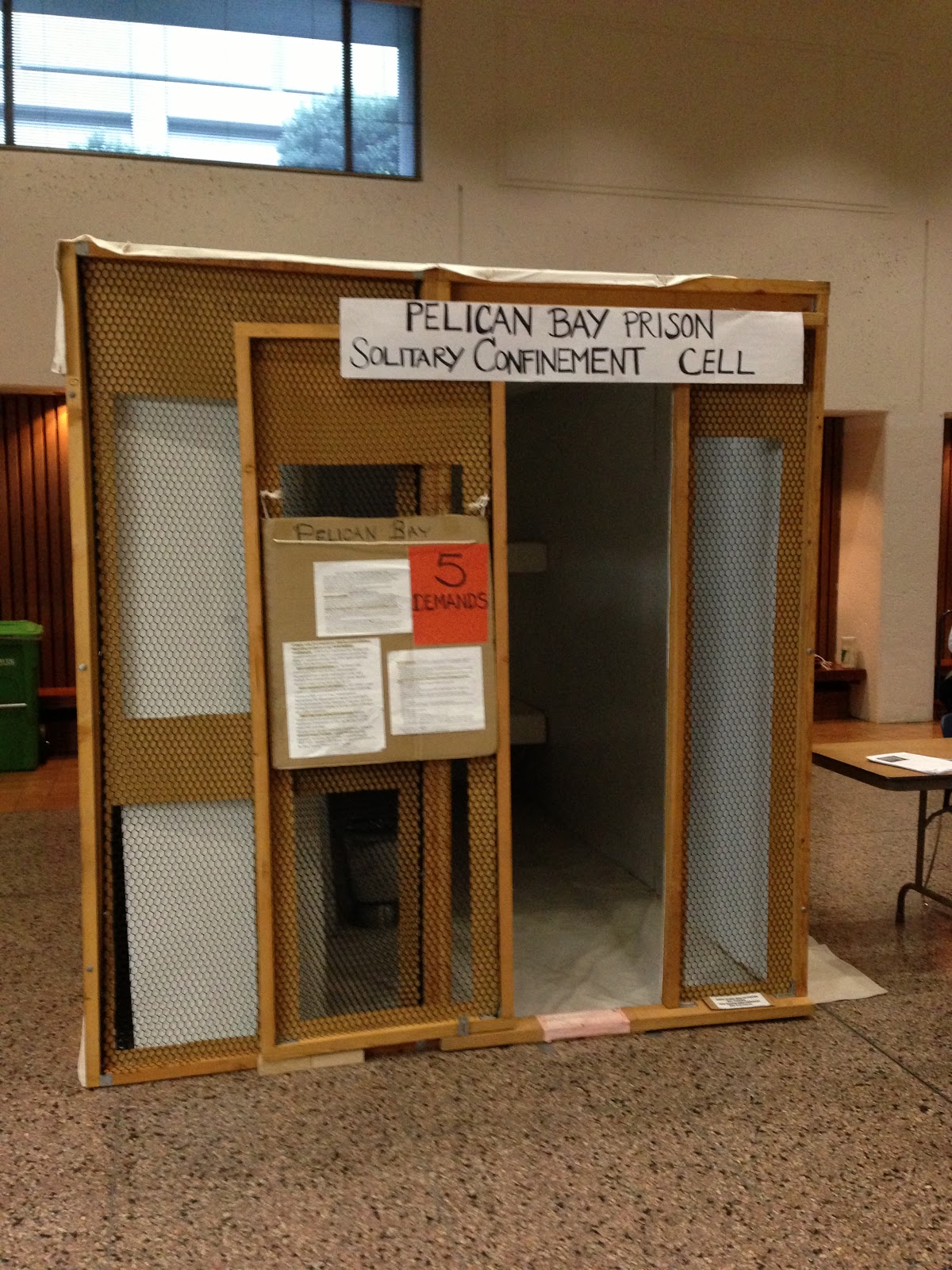
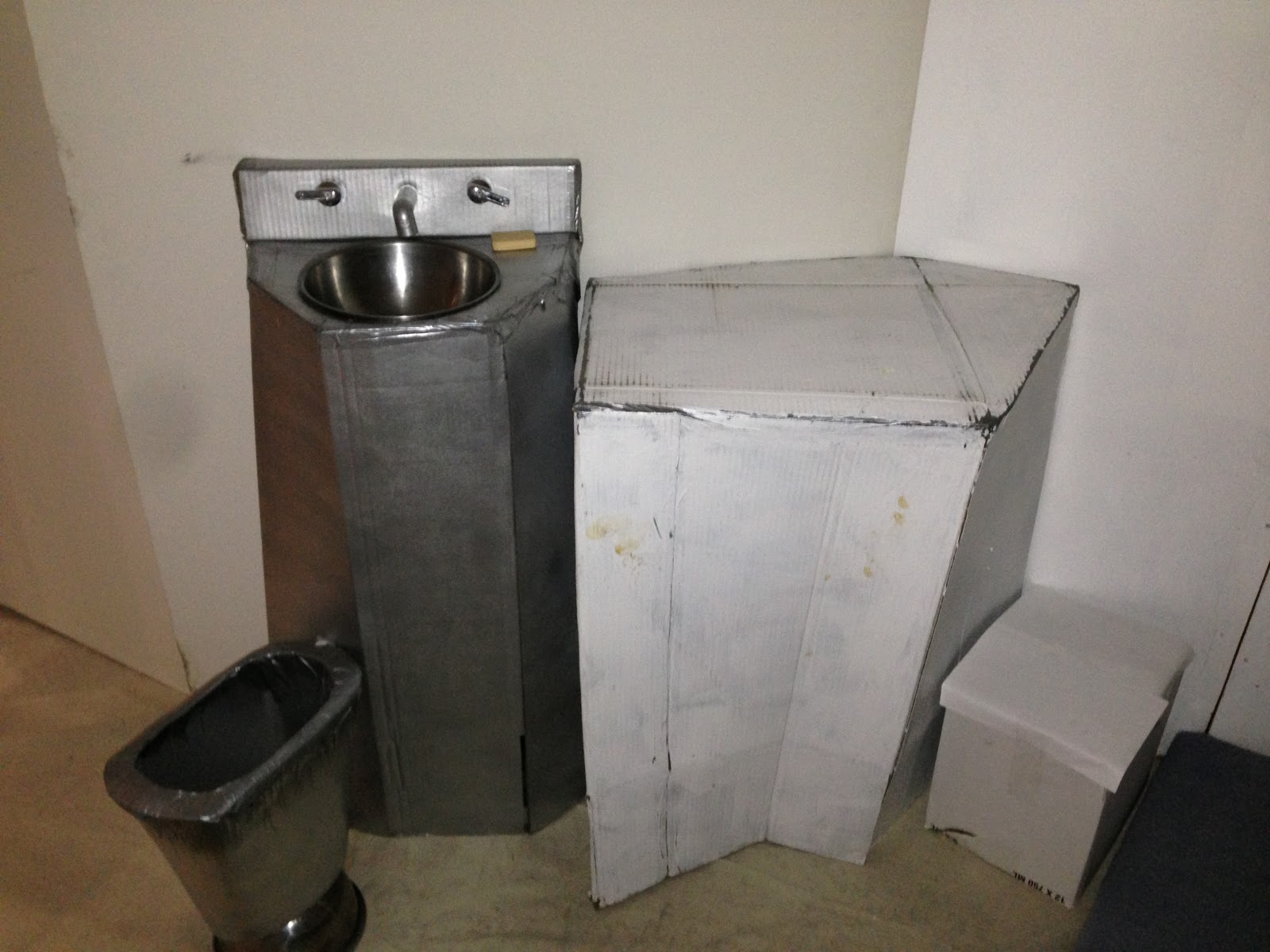
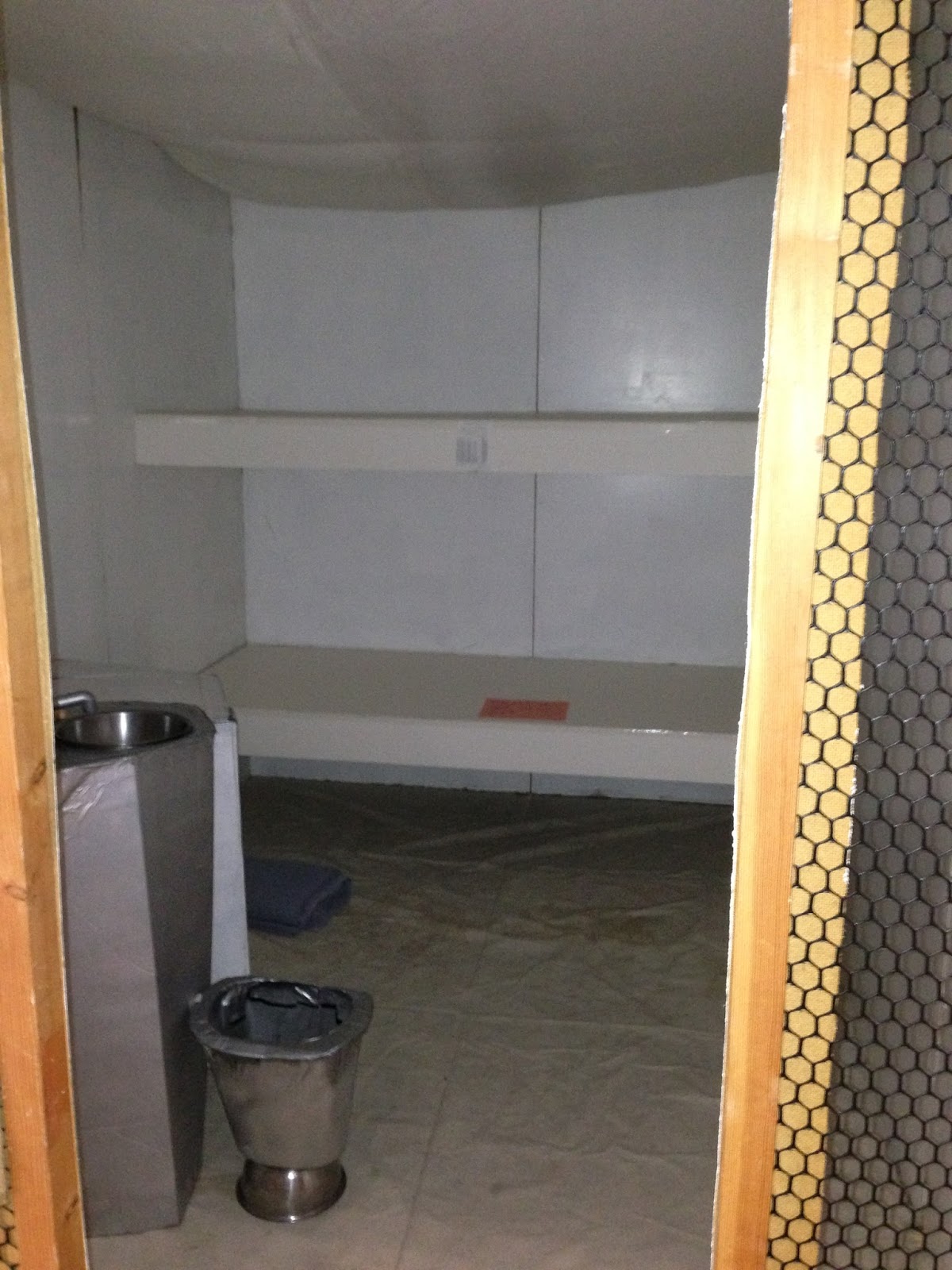
What an incredible evening we had at UC Hastings Tuesday night! Our wonderful panel titled “Pelican Bay Hunger Strike Resumes: The Continued Struggle to End Long-Term Solitary Confinement in California” was accompanied by a life-sized model of a solitary confinement cell found in California’s Secure Housing Units (SHU). Urszula Wislanka and Penny Schoner from the Prisoner Hunger Strike Solidarity Coalition were extremely helpful in getting the model SHU prison cell set up for tours. The model SHU cell is a life-sized 8’x10’ windowless cell that the Prisoner Hunger Strike Solidarity Coalition brings to various events in California. It is eye-opening for people to actually step inside and get a small glimpse of the tiny, cramped space that many prisoners held in solitary confinement have to live in for decades. On a table to the side of the model SHU, we had letters that people could send to Governor Jerry Brown, explaining how they felt when they stepped inside the cell. The Governor has been largely silent on the issue of solitary confinement in CA prisons, and we want to urge him to respond meaningfully to the torture that has been going on for far too long, since even before Pelican Bay State Prison SHU was constructed in 1989.
As we watched people enter and emerge from the model SHU, we were able to see the shock on their faces when they experienced how claustrophobic that small space made them feel, even for just a few moments. Many people said they were surprised by how small the cells are, how many hours prisoners are held in their cell per day, and how many years prisoners are kept in solitary confinement! This sense of shock is the reason we need to have as many events like this as we can; most people simply do not know that this torture is going on in their beloved State of California.
The panel was moderated by the lovely Hadar Aviram, who did a wonderful job introducing all the panelists and asking the right questions to get the discussion going. The first panelist to speak was Charles Carbone, a seasoned prisoner rights lawyer and counsel on the Ruiz v. Brown lawsuit filed by prisoners who have spent more than ten years in SHU, who is well-versed on the intricacies of CDCR’s policies and rhetoric. He outlined a history of solitary confinement, explaining the 19th century puritan societal worldview that giving a person a Bible and sending them to do “penitence” in solitary confinement would reform them. Ultimately, that policy experiment was deemed a rehabilitative failure, but American government has embraced solitary confinement anew in recent decades. Carbone also challenged CDCR’s “new” policies as being even worse than their former practices. Prisoners are still being held indefinitely in solitary confinement for their political and cultural tattoos, artwork, and written material that prison officials deem “gang activity,” without any evidence of violent or threatening behavior, and with no meaningful opportunity for release.
Steven Czifra and Jose “Danny” Murillo, UC Berkeley students who have both been incarcerated for years in the SHU, went on to describe their experience of long-term extreme isolation in the SHU. We were haunted by Steven’s analogy that the SHU is just like “a bunch of ghosts trying to cheer each other up.” He repeatedly mentioned how kind and humane people in the SHU acted towards each other. “It only took one person who believed in me,” said Stephen. Stephen is now studying English at UC Berkeley and has a wonderful family life. Danny said that growing up, he struggled with anger issues and was never the best student. During his time in the SHU, he was inspired by the help and encouragement of his fellow inmates who believed in him. He earned his GED and took some college classes through the educational programming CDCR has since eliminated from the SHUs. Danny is now an undergraduate student at UC Berkeley in the Ethnic Studies Department. And to think that these two were labeled the “worst of the worst!”
The next speaker Terry Kupers, is a clinical psychiatrist and expert on the mental health impacts of long-term solitary confinement. Terry testifies in a lot of litigation involving jail and prison conditions and how those conditions affect prisoners’ mental health. He was right on the money with everything he said last night. Terry emphasized the important fact that locking people up in solitary confinement does not reduce the violence rate in prisons. In fact, research has proven the opposite. He also emphasized how the Eighth Amendment’s ban on “cruel and unusual” punishment and “torture” were essentially the same; the only difference is that we don’t like to talk about torture here in the United States. We like to think of torture as something that goes on in distant “less civilized” countries. We are uncomfortable with the idea that our government tortures its citizens, but until we acknowledge that this is happening, there will be no change. If the only way to escape solitary confinement is to “parole, debrief, or die,” how is that anything but torture?
Marie Levin spoke about how solitary confinement hurts other people besides just the prisoners in solitary; in particular, their family members and the communities they have been removed from. Marie is the sister of Sitawa Nantambu Jamaa, who has been in the SHU at Pelican Bay since 1990. She has not hugged her brother in over two decades and has only been able to see him 10 times since he’s been at Pelican Bay. She told the heartbreaking story of their sister Carol’s death in 2010. Carol had kidney failure in 2001 and after discovering this, Sitawa wanted to donate a kidney to save his sister’s life. The prison would not allow him to make the donation, and after years of fighting this, Carol died in a puddle of blood after a dialysis treatment. This is just one of the many horrifying stories brought to you by California’s solitary confinement regime. Ashley, co-author of this article, had the privilege of meeting Sitawa last week on our visit to Pelican Bay, and when he told this same story, she had to fight back tears.
Azadeh Zohrabi, a Soros Justice Fellow, Hastings alum, and the brilliant woman who is spearheading the Stop the Torture campaign to end solitary confinement in California spoke next. She focused her comments on the 2011 hunger strikes and how the prisoners’ demands are still not being met by CDCR, despite their promises of reform that ended the strike. Although they have new regulations, they do not meet the prisoner’s very reasonable demands, and the prisoners have announced that the strike is set to resume July 8th of this year. She spoke about the importance of the Stop the Torture campaign and raising awareness around this issue. She remarked that perhaps the dangerous and painful hunger strike could be avoided if this issue gets enough attention before July 8th. She said that people don’t just go on hunger strike for fun. Lives were lost during the last hunger strikes and people lost a lot of weight and had significant medical complications resulting from the strike. The fact that prisoners would risk their lives to bring attention to the conditions of their confinement is a testament to how dire the situation is. During our visits to Pelican Bay last week, many men indicated their commitment to see this strike through if the results they were already promised are not reached. One inmate, in describing why he would risk his life in a hunger strike, said, “It’s no life in here.”
In total, approximately sixty guests attended the event and we are hoping a lot of them will trickle in to the State Building over the next couple days for the “California Correctional Crisis: Realignment and Reform” symposium! There will be ample opportunity at the symposium to delve deeper into the issues California faces in its multi-faceted correctional crisis. To stay plugged into this issue, visit Stop Torture CAand follow us on Twitter @StopTortureCA.
Breaking news from the Prison Law Office: Three inmates at the Riverside jail have just served a federal action suit over their conditions, particularly the appalling health care. The press release provides two poignant examples:
Angela Patterson, a plaintiff in the case, suffered nearly a year of delays, cancellations, and inadequate medical care for severe injuries she sustained in a car accident prior to entering the jail. As a result, a temporary filter implanted near her heart cannot be removed, and she will suffer a lifetime of anticoagulation medications and frequent laboratory monitoring, with significant risk of fatal bleeds and other complications. Quinton Gray, another plaintiff, was given potent psychotropic medication without appropriate evaluation or follow-up, placing him at risk for life-threatening consequences. As a result of the medication mismanagement and treatment failures, he lives with agonizing side effects: twitching, tongue-biting, increased seizures and tongue swelling, racing thoughts, disorientation, depression, and chronic sleep loss.
The inmates complain that the slashing of medical care budgets in Riverside have yielded unacceptable practices. They are represented by the Prison Law Office and by Akin Gump Strauss Hauer & Feld, LLP.
Before Realignment, one of the arguments in favor of shifting inmates from prisons to jails was that surely the counties would do a better job than the overcrowded state institutions. This is not the case in several jails, and we might see an increasing number of lawsuits focused on unacceptable jail conditions.
Today’s panel will feature people who have done time in the SHU, family members of current SHU inmates, doctors, lawyers, activists… a real opportunity to hear insiders’ accounts of the experience and the struggle.
When: Tours of life-sized model of a SHU cell from 1:30pm; panel at 6:00pm.
Where: Louis B. Mayer Lounge, UC Hastings, 198 McAllister Street (cross street Hyde), San Francisco.