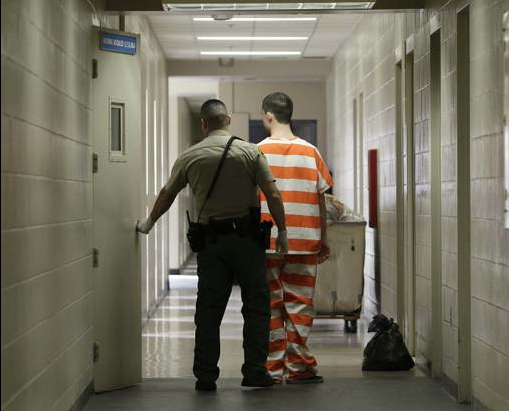
Solitary Confinement Punishes Families, Too

The Huff Post published a beautiful piece by Marie Levin, whose brother Ronnie (Sitawa) has been held in solitary confinement for the last twenty-three years.

Marie’s piece is a reminder that solitary confinement is punishment not only for the segregated party, but for his/her family as well.

I have only seen my brother ten times since he has been at Pelican Bay. The drive is almost eight hours, I don’t own a car, and travel and lodging are very expensive. There is so much time between visits that each time I see him, Ronnie looks much older. We’re not allowed any contact at all during visits, and the prison only allows us visits of one-to-two hours.

But this is hardly the worst our family has suffered while Ronnie has been in the SHU. In 2001, our sister Carol suffered kidney failure. Ronnie was a compatible kidney donor, but the prison would not allow him to make the donation. For years, Ronnie fought for permission to save his sister. Carol died in 2010, in a puddle of blood, bleeding out after a dialysis treatment.

Now, our mother is seriously ill. She has had several strokes, is paralyzed on her right side, has trouble speaking, and suffers from cognitive difficulties. She longs to see her only son, but she is no longer able to make the long, difficult trip. I am faced with the heartbreaking realization that she may never see her son again solely because of his writing and reading material – his unjust imprisonment in the SHU that has kept him from being paroled for almost two decades.

This is an extreme example of the multiple ways in which mass incarceration destroys families and communities, invading and harming countless lives beyond those behind bars.

Marie will be one of our speakers at tomorrow’s panel on solitary confinement. The event is at 6pm, at UC Hastings, 198 McAllister Street. We will have a life-sized model of a SHU cell and hear from people formerly incarcerated in the SHU, family members, doctors, lawyers, and activists. Please join us for all-day tours of the SHU and for the evening panel.

And of course, if you have not already done so, please plan to join us Thursday and Friday for California Correctional Crisis: Realignment and Reform.

Why Civil Representation Matters

For the most part, this blog covers criminal and correctional matters. But this New York Times story makes me think that the distinction between criminal and civil law isn’t all that clear-cut.

As it turns out, the economic downturn has worsened a situation in which poor people don’t have access to lawyers and have to represent themselves in matters such as home foreclosures, child custody, job loss and spousal abuse. Without the knowledge and connections that an attorney can provide, and unshielded from the power of the law, the quality of justice poor people receive is reduced. The article reports:

The Legal Services Corporation, the Congressionally financed organization that provides lawyers to the poor in civil matters, says there are more than 60 million Americans — 35 percent more than in 2005 — who qualify for its services. But it calculates that 80 percent of the legal needs of the poor go unmet. In state after state, according to a survey of trial judges, more people are now representing themselves in court and they are failing to present necessary evidence, committing procedural errors and poorly examining witnesses, all while new lawyers remain unemployed. 

. . . 

According to the World Justice Project, a nonprofit group promoting the rule of law that got its start through the American Bar Association, the United States ranks 66th out of 98 countries in access to and affordability of civil legal services.

In April, thanks to a city ordinance championed by civil rights lawyer Robert Rubin and big firm partners James Donato and James Brosnahan, San Francisco became the first city to offer a “civil Gideon” pilot program, guaranteeing representation to the indigent in civil matters as well.  A 2009 California law funneling funds to legal aid groups to provide representation was bitterly contested, as was the San Francisco ordinance.

Why does all this matter? Because formerly incarcerated people rebuilding their lives on the outside may find that their brushes with the law happen outside the criminal realm, as well. Having to deal with the side effects of poverty and discrimination against felons (jobs and housing) and with the disintegration of family so commonly associated with incarceration, one might find oneself in dire need of an attorney, finding that outside of criminal matters, representation is difficult. “Civil Gideon” projects are, therefore, as important to reentering folks as criminal representation – perhaps more so.

But high caseloads, both civil and criminal, mean that even laws guaranteeing representation may find it difficult to offer quality representation. This is what I’ve referred to elsewhere as “the dark side of Gideon.”More funding means better representation, and this is one area in which humonetarianism will not be of much help.

Finally, apropos Gideon, this flick has just been released and should be worth seeing when it comes to California. Here’s a Democracy Now segment devoted to the film:


————–
Robert Rubin, whose main area of litigation in the last ten years is voting rights, will be speaking at our conference on Friday about felon disenfranchisement and barriers to reentry.

U.N. Expert on Torture Calls for Investigation of Use of Solitary Confinement

Today’s International Law Prof Blog reports:

The United Nations expert on torture has called on the Inter-American Commission on Human Rights to investigate the practise of solitary confinement and its harmful effects in the Americas, particularly in Latin America, and urged stronger regulation of its use. “I am concerned about the general lack of official information and statistics on the use of solitary confinement,” the Special Rapporteur on torture, Juan E. Méndez, told the Inter-American Commission on Human Rights in its first-ever briefing on solitary confinement in the Americas. “The use of solitary confinement can only be accepted under exceptional circumstances, and should only be applied as a last resort measure in which its length must be as short as possible,” the Special Rapporteur added at the meeting in Washington D.C. 

 Mr. Méndez warned that there are insufficient safeguard mechanisms in the region for preventing, detecting, and responding to the use of solitary confinement, such as making sure that the prisoners held in solitary confinement retain access to legal counsel and medical assistance. He also called for the absolute prohibition of solitary confinement for juveniles and persons with mental disabilities and for an equally absolute prohibition on indefinite or prolonged solitary confinement lasting longer than 15 days.

 “It is important for States to advance in modifying their legislation, policies and practices that are not in accordance with these standards,” he urged. Mr. Méndez spoke to the Commission, which is part of the Organization of American States, in his capacity as an unpaid independent expert appointed by the UN Human Rights Council to examine and report back on thematic issues. In a 2011 global report to the UN General Assembly, Mr. Méndez called solitary confinement a “harsh measure which is contrary to rehabilitation, the aim of the penitentiary system.”

While getting U.N. attention is never a bad thing when human rights violations are involved, I am dubious that any sort of international censure is going to improve matters. American exceptionalism seems to have resisted it for many years with the death penalty. I wonder what sort of international pressure would make the U.S. receptive to critique – thoughts?

For more information on solitary confinement and its overuse/misuse in the California context, please join us this Tue for a viewing of a life-sized model of a SHU cell as well as a panel at 6:00pm. And of course, save some intellectual energy for our upcoming conference, California Correctional Crisis: Realignment and Reform.

————-
Props to colleague Chimène Keitner for the link.

More From Jerry: Federal Prison Oversight a Waste of Money?

Photo credit Randall Benton for the Sac Bee.

After Governor Brown’s public comments about attorney’s fees for inmate rights’ litigators – on which we had plenty to say here and on The Recorder – he’s back to it this morning. The Sac Bee reports:

“During the life of these lawsuits, the prison health care budget has gone from $700 million to $2 billion,” Brown said in an interview with The Bee, his first on the issue since the state filed court documents in January seeking to regain control of its prisons. 

“That money is coming out of the university, it’s coming out of child care. It’s a situation you wouldn’t dream anyone would want.” 

The governor’s comments came as lawyers prepare for a battle in Sacramento federal court later this month over whether the state is providing a constitutional level of mental health and medical care for inmates. Oral arguments are scheduled for March 27 on California’s motion to terminate oversight of mental health care by U.S. District Judge Lawrence K. Karlton. 

Another motion by the state, also filed in January, seeks to vacate or modify an order by a specially convened three-judge court to reduce inmate population. Oral arguments on that motion have not yet been scheduled. 

Really, Jerry? Really? You reap what you sow. Why is the prison health care budget so costly? It’s true that mistreating and ignoring people’s medical plight is cheaper than actually treating them, but perhaps if treating them is so expensive then one should have considered whether so many of them should have been in prison in the first place. And whose fault is it that prison expenditures are higher than what we spend on education and child care? Complaining about this given that the government is the culprit is absurd, offensive, and inflammatory.

Conservative Case Against More Prisons

I recommend reading this article recently published in The American Conservative: “The Conservative Case Against More Prisons,” by Vikrant Reddy and Marc Levin of Right on Crime.

For its arguably humonetarian overtones, my favorite passage is this quote from the governor of Georgia:

Texas is just the beginning. In 2012, Georgia, under Republican Governor Nathan Deal, passed the nation’s most sweeping corrections reform bill. Deal has shown a particular interest in rehabilitating drug offenders, and he has framed his arguments in recognizably conservative language on taxes: “If we fail to treat the addict’s drug addiction, we haven’t taken the first step in breaking the cycle of crime—a cycle that destroys lives and wastes taxpayer resources.”

Book Review: Life After Death by Damien Echols

The West Memphis Three case, which attracted much public attention due to Joe Berlinger and Bruce Sinofsky’s HBO series Paradise Lost, Revelations, and Purgatory, resulted in an Alford plea in 2011. The aftermath of the case, and many details previously unrevealed, were told in the recently released West of Memphis. And now, there is an opportunity to get the personal perspective of the major protagonist in this riveting epic miscarriage of justice: Damien Echols, author of Life After Death.

The book offers very little information on the trial itself, which has been extensively covered elsewhere. Instead, Echols offers a rich account of his family background and personal history. Born to an unstable home, frequently on the road, and labeled a troublemaker, Echols befriended to-be codefendant Jason Baldwin. Some context for his arrest is provided by his interactions with overzealous police officers obsessed with Satanism and eager to label and stigmatize misfits they associated with occult practices. And, we hear a bit more about the birth of his son during the course of the trial.

The book’s chronology leaps back and forth between memories of these events and current writings of prison experience, deliberately undated because of the harmful psychological effect the passage of time had on Echols on Death Row. But we do get descriptions of the other inmates, many of which are incredibly disconcerting. We have rules against executing the mentally defective, Echols says, but segregation and Death Row are not only a home, but a catalyst for mental disorders and defects.

These stories ring authentic, but they are not unnecessarily sensationalized; Echols’ focus is directed inward, into his personal growth and enrichment experience behind bars. In an effort to avoid going mad or stifled, he turns his cell, as some inmates advise him, into “a school and a monastery”, becoming a voracious reader and immersing himself in spiritual practices, primarily Catholicism and Zen Buddhism. This inner journey is the focus for much of the book, as it drives not only the memories of the past, but also a way to handle and manage the expectations and hopes for the future. It is particularly poignant to read of this inner journey on a week in which we are holding an event to reignite the struggle against solitary confinement in CA, in which we expect to host people who have spent time in the SHU, as well as a life-size model of a SHU cell.

The book does offer a suspenful, blow-by-blow account of the events leading to the Alford plea, and some of Echols’ experiences post-exoneration, which will be of interest to those who have followed the case. And much of the book is a love letter to Echols’ devoted wife Lorri, as well as a recognition of friendship and gratitude to the many people on the outside who worked tirelessly for his exoneration. Those of you who have seen the movies and read about the case will find Life After Death a reflective companion to the facts and procedures, and appreciate the unique window into Echols’ inner life.

Reviving the Fight Against Solitary Confinement

It’s going to be a momentous week: On Tue, March 19, we’ll hold an event to reignite the struggle to end long-term solitary confinement in California.
The Louis B. Mayer Lounge at UC Hastings, at the ground floor of 198 McAllister Street, will host a life-size model of a SHU cell. Everyone is invited to come and take a tour of the SHU throughout the day. And when you do, think of what it’s like to live in a cell like that… not for a five-minute tour, but for years, 22.5 hours a day.
And at 6pm, we’ll be holding a panel featuring people who have done time at the SHU, activists, lawyers, and family members. 

The event is free and open to the public. More information on the event’s Facebook page.

And of course, two days later, on Thu, March 21, we’ll hold our big conference, California Correctional Crisis: Realignment and Reform. Please register, come, and bring friends.

Film Review: Life With Murder

A gentle, quiet, middle-aged Canadian couple is faced with one of the most horrific dilemmas imaginable: How do you cope with having your child been murdered… by your other child?

The excellent 2010 documentary Life With Murder follows Brian and Leslie Jenkins from Chatham in this horrific ordeal. A short driving distance from Detroit, where a murder occurs every day, in Chatham a murder occurs every year. “Unfortunately,” says Leslie, “1999 was our year.”

Jennifer Jenkins, 18, was a much-beloved and popular girl, and the town was stricken with grief when she was found shot to death in her home. Suspicion quickly fell on her brother, Mason (20 years old at the time), who tried to escape the house… on a horse.

Mason, Brian and Leslie’s interviews at the police station are shown on camera, as is the original 911 call from the parents who discovered the body. Mason insisted, against a mountain of condemning evidence, on his innocence and filed numerous appeals. His parents stood squarely behind him, not speaking about the events of the night of the murder for many long years, until Mason exhausted his appeals… and changed his story. And after these developments, their choices as a family are nothing short of remarkable.

Of special interest to readers of this blog is the incredible footage from Canadian prison. Mason is on friendly terms with a correctional officer, with whom he comfortably and amiably shares details of the night of the murder. Visitation happens in a natural, home-like setting: Mason’s parents grill meat with him in a yard with lawn around the cottage in which they visit; they get to spend visiting weekends with him in the little cottage. In one scene that will stun U.S. viewers, Mason and his mother cook a meal in a kitchen with knives on the wall. The contrast to the visitation experience in U.S. institutions is palpable.

But the most interesting aspect of the film is its gentle, and yet painfully honest, treatment of denial and detachment, and its subtle probing into the psyche of loving, introverted people gradually uncovering untold horror and coming to terms with it in their own way. In his insightful commentary about the film, director John Kastner talks about the difficulty of conducting “a major investigation of a subject when the participants don’t want to discuss it.” He writes:

Brian and Leslie were generous with their time, but would they open up to us? Or were they living – as some suggested — in a kind of Never-Never land, refusing to face facts about Mason? And how to explain their steadfast support of him, visiting him in prison regularly? (How could they talk to him? Look at him? Have anything to do with him?) 

A colleague and I began meeting them in Chatham for well over a year, often twice a month, gradually peeling back the layers of their psychological armour. At first they revealed very little. But it became apparent they were more aware of the awful details of the murder than they had initially let on. They parked the information in a mental drawer, so to speak, as a survival mechanism to help get them through the day. 

Eventually they decided they had bottled up their story for too long; it would be therapeutic to discuss it with someone besides a shrink who was sympathetic and who was familiar with the criminal justice system. Important to them, too, was helping other families learn from observing their own tortured efforts at healing and reconciliation. 

I think the Jenkins are wonderful people. I so admire their great character and integrity. Many in their shoes would have tried to protect their son by fudging the facts to the authorities. But the Jenkins’ remarkable, often painful, honesty is apparent in their videotaped interviews with the police – not to mention in their interviews with us.

Life With Murder streams on YouTube and on Netflix.

———
Props to Katie Morrison for the recommendation.

Realignment and Long Jail Terms

An inmate in the Madera County Jail is taken to the inmate
housing unit. Photo courtesy The Press Enterprise.

Realignment was initiated, in part, as a reaction to the ruling in Brown v. Plata and the belief that, whatever the conditions in local jails, surely nothing could be worse than state prisons. But is that true? The Press Enterprise reports that more than 1,100 people are serving terms between 5 and 10 years in county jails, some of which are seriously ill equipped to handle such long sentences.

Authorities originally believed that the maximum jail sentence under realignment would be three years, and anyone with a lengthier sentence would go to prison.

But judges found no legal grounds to send convicted inmates to state prison for most violations detailed under realignment. The number of inmates getting lengthy sentences to county jails has been rising ever since.

County law-enforcement officials are concerned that increasing the number of long-term jail inmates will lead to a new round of prisoner rights-violation lawsuits. Jails originally were meant to hold sentenced inmates for no more than a year. They don’t have the medical, mental health, disability and work-program facilities found at state prisons

Fresno County already has been sued by inmates claiming mental health and medical care in its jails is inadequate. A prison-rights law firm has been reviewing Riverside County’s facilities.

The piece goes on to document some anti-Realignment bills aimed at minimizing its effects by excluding more categories of offenders or setting a sentencing limit. The fact that there is now one person sentenced to 42 (!) years in L.A. County Jail (presumably for a nonserious, nonviolent, nonsexual offense) should be an indication that reform is being done in a horribly wrong fashion.

——–
Props to Josh Page for the link. Come talk to us about realignment at our conference, California Correctional Crisis: Realignment and Reform, on March 21-22.