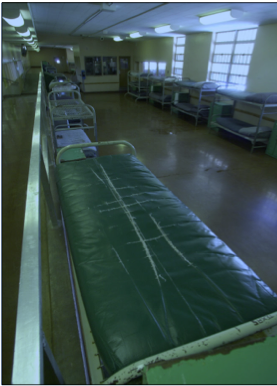

![]() |
| Photo courtesy Todd Heisler for the New York Times. |
Death Penalty Abolition Bill – to Ballot
SAFE California, a voter initiative to abolish the death penalty and replace it with life without parole, has succeeded in collecting the necessary 750,000 signatures to place the initiative on the ballot. So, come November 2012, California voters will have the opportunity to join Alaska, Hawaii, Illinois, Iowa, Maine, Michigan, Minnesota, New Jersey, New Mexico, North Dakota, Rhode Island, Vermont, West Virginia, Wisconsin and the District of Columbia.
Death in Corcoran
A recent episode of Democracy Now! features an inquiry into the death of Christian Gomez, 27, an inmate at Corcoran State Prison, who passed away six days after the beginning of the hunger strike. His sister, Yajaira Lopez, is calling for an investigation to what happened inside the prison and for conditions to be drastically improved. “When he did get [to Corcoran State Prison], he did explain to us that he was participating in a hunger strike,” Lopez explains. “They were fighting for fair treatment.”
Also interviewed is Carol Strickland of the Prisoner Hunger Strike Solidarity Coalition and Prisoners With Children, who reports having heard that “people were not getting medical care who were on hunger strike and that that’s been something that we saw previously, as well, that the medical care is withdrawn, in many ways. Medications are stopped, and people are not being cared for adequately. And one has to ask, how can this man basically drop dead, you know, after only
a few days of a hunger strike, when he’s under medical care?”
Mendocino Snuffing Medical Marijuana Experiment
Yesterday’s NPR story on Mendocino County’s medical marijuana regulations is an especially good illustration of the practical effects of the conflict between federal, versus state and local, criminal laws.
“All of it left County Board Chairman John McCowen exasperated. ‘It means it’s going to go back underground. It’s going to become more dangerous. It’s going to become more profitable for the black marketers,’ he says. ‘I just don’t see that this represents progress.'”
Grool(TM)
What a terrific little recipe this is; a mix of fruit salad, an oatmealish-substance without oatmeal, and lots of kick from dried fruit. Makes for an excellent breakfast. Feeds four.
Two red apples
two oranges
five medjool dates
five dried figs
five dried plums
30 almonds
20 macadamia nuts
soymilk or almond milk (plain or vanilla flavored)
orange, apple or prune juice
cinnamon
Soak almonds, macadamia nuts, figs and plums in boiling water first thing in the morning.
Thinly chop apples and oranges. Combine in a bowl with a splash of soy or almond milk and a splash of juice. Strain nuts, figs and plums, and thinly chop or grind. Add to fruit in bowl and mix well until thing reaches cereal-like consistency. Add cinnamon to taste.
Anticipating a CCC Conference Sequel in 2013
We’re in the early stages of planning a sequel to our 2009 California Correctional Crisis conference. We expect to be covering the aftermath of Brown v. Plata, news about the death penalty, the drug war, sentencing alternatives, parole reform, and many other topics near and dear to the hearts of our readers. Like the previous conference, which was attended by hundreds of people and featured experts and policymakers from all over the country, this will be a huge public event, and now’s the time to provide your input as to the content you’d like to receive.
Concern in Pelican Bay: Increase in Solitary Confinement?
A disconcerting trend predicted on the San Francisco Bay View: The depopulation of prisons may be accompanied by an increase in the use of solitary confinement. The mostly-unreported hunger strike of September and October was in manifestation of inmate concerns with the change in security groups. Here’s more information, as per letters from Todd Ashker, the strike organizer:
Written Jan. 22, postmarked Jan. 27, 2012 – As soon as I first heard during our face to face meeting with former Undersecretary Kernan of CDCR’s plans to go to a “security threat group” (STG) system of classification, I recognized the very real potential for manipulation and abuse of such by certain factions in power positions in CDCR – e.g. CCPOA (California Correctional Peace Officers Association), gang unit etc. I immediately detailed my concerns to our attorneys – this was part of the reason for hunger strike no. 2 in September and October.
Briefly, here’s what I’m concerned about: Right at the time – in May – when the U.S. Supreme Court upholds the lower court’s prison population reduction order, in seeming response to our July hunger strike, CDCR unveils their STG plan. Here’s how it looks to me: The prison population reduction of 35,000-40,000 prisoners equals a potential loss of $2 billion in the yearly CDCR budget and the loss of approximately 7,000 CCPOA members. That’s the loss of a lot of union dues!
A clever way to offset some of this loss is to create a “new” security threat designation scheme – used in a lot of states, including Arizona, where it’s used to isolate all inmates labeled southern Hispanic from California – enabling CDCR to segregate a lot more men. Segregation costs nearly double general population and requires more staff.
Does any of our readers have more information about this?
Realigning Juvenile Institutions
![]() |
| Sam Mateo County facility; photo courtesy CJCJ publication. |
![]() |
| OH Close YCF; photo courtesy CJCJ publication. |
While we remain curious as to the ability of county jails to supplant state institutions for a considerable percentage of the adult population, a similar move for juvenile offenders seems to offer more optimism. A new publication from the Center on Juvenile and Criminal Justice takes a comparative look at state and county juvenile institutions, being much more impressed with county modern facilities than with the disturbingly grim and defunct state institutions. The bottom line:
The review demonstrates that local secure county-based facilities currently surpass existing state youth correctional facilities in architectural design and structural integrity. Due to various federal grants and funding stream requirements, counties have renovated and enhanced their juvenile facilities to provide maximum, medium, and minimum security levels of custody that allow for provision of fully integrated rehabilitative services on-site. 41 California counties have already invested $438,612,750 of state and federal funding to renovate or construct new maximum-security juvenile halls within the last five years. Meanwhile state facilities have continued to decay into a condition of disrepair.
Perhaps this report will provide prosecutors with disincentives to file charges against juvenile defendants as adults, a practice known as “direct filing”, whose usage varies between counties (Ventura County seems the worst offender). The impetus to do so stems from the fact that trying juveniles as adults shifts the price tag from the county to the state. But if the choice is between a distant adult state prison and a local, modern juvenile facility, which might be closer to support structure and offer community corrections benefits, in the long run it may be cheaper for all of us.
Realignment: Potential and Pitfalls
![]() |
| Photo courtesy Jamie Soja for SF Weekly. |
Today’s SF Weekly features a detailed story by Lauren Smiley about rehabilitative initiatives for realignment inmates in San Francisco jails, complete with data, anecdotes, and an interview with yours truly. To whet your appetite about the story:
Last May, the U.S. Supreme Court upheld a three-judge ruling that California must reduce its overcrowded prisons to 137.5 percent of capacity by mid-2013, down from a peak of 202 percent capacity in 2006. That meant siphoning out about 34,000 prisoners, enough inmates to nearly fill the Oakland A’s stadium.
The state came up with a plan: Nobody gets out of prison early, but less-serious offenders would be sentenced to county jail, and the supervision of certain criminals released from prison would be moved from state parole agents to county probation officers. That means that if these ex-cons violate the terms of their release, they will be booked into county jail, not prison.
Voilà: Prisoner numbers are down for the state. The prisons are currently on track to meet the deadline, at 164 percent capacity and descending.
So San Francisco will now attempt what the state corrections system failed at: rehabbing Nate Bracy. It will try to override 17 years of criminal behavior and to get him — and the 700 others who will arrive in San Francisco over the next two years — to live like your average Joe Citizen.
BREAKING NEWS: Bill to Amend Three Strikes Law Passes Assembly
Assembly Bill 327, introduced by Assembly Member Davis, passed in the assembly today. The new bill, whose text can be found here in full, would activate the “third strike” life imprisonment provision only if the third felony is for a serious or violent felony.
What counts as “serious or violent” felony is defined in section 667.5 of the existing penal code. The category includes serious offenses like murder, attempted murder, rape and kidnapping, but also first degree burglary, extortion and the like. It would seem to exclude some of the more scandalous examples of three strikes practices, in which the third offense would be petty theft of some sort.
The bill now moves to the senate floor. But getting too excited about this may be premature; the bill explicitly specifies that it only comes into effect if approved by voters in the 2014 election.