Juvenile Solitary Bill Fails

Amidst the joyous news following the settlement in Ashker v. Brown comes a less encouraging development: AB 124, which would severely limit the use of solitary confinement in juvenile facilities (to four hours at a time, and not as a form of punishment), failed in the Assembly Appropriations Committee and won’t be proceeding forward. The East Bay Express reports:

Proponents of SB 124 — co-sponsored by state Senator Mark Leno, D-San Francisco, and the Ella Baker Center for Human Rights, an Oakland nonprofit — have argued that the bill could go a long way in protecting youth inmates in county and state facilities from the inhumane and unjustified practice of isolation. The documented psychological deterioration associated with solitary confinement — which was a key argument in the state class-action suit — can be especially damaging for vulnerable youth inmates who have often already experienced a wide range of trauma in their lives. With California now agreeing to dramatically curb the use of isolation for adults and with officials increasingly acknowledging the harms of solitary, the failure of SB 124 was particularly painful for advocates who have been pushing versions of the bill for several years. 

“We’re talking about the health and lives of young people who are endangered by this practice,” Jennifer Kim, Ella Baker Center’s director of programs, told me yesterday. Kim helped write the legislation and has repeatedly amended the bill in response to criticisms of correction officials, who have continued to argue that isolation of juveniles is an important tool to control “dangerous” kids. In reference to the state lawsuit and settlement, which will have no impact on juvenile facilities or inmates, Kim added, “Thousands of adults are going to be ordered out of solitary confinement … [because] the courts have had to intervene. … And yet the legislature has been largely not leading in the way they could be.” 

SB 124, which successfully passed the Senate in June, would ban the use of solitary confinement in juvenile facilities for longer than four hours at a time. The legislation would also prohibit correctional officers from using solitary as a form of punishment and would only allow isolation when youth pose an immediate, substantial risk to themselves or others. Facilities would also be barred from isolating inmates who pose a threat as a result of a mental disorder. Additionally, the legislation requires jails to document all instances of solitary through a statewide reporting system. Correction and probation officials across the state have consistently opposed the measure, arguing that facilities do not use the kind of inhumane solitary confinement tactics that advocates describe. The opponents have also contended that the restrictions of SB 124 would put staff and youth at risk by making it harder for officers to isolate violent youth. 

What with SB 261 passing only recently, the California legislature’s approach to juveniles can only be seen as puzzling. Are we treating them as children? as adults? for what purposes? are we willing to resentence but not to limit solitary confinement? and, under the circumstances, what is worse–adult prison or state juvenile facilities?

Join us on 9/17 to discuss these issues with juvenile justice advocates.

Three Jail Guards Arrested in Santa Clara Jail Inmate Death

The shift of numerous inmates from state prisons to county jails has turned our attention to conditions in these local institutions. This morning’s news present a particularly tragic example: the brutal killing of 31-year-old Michael Tyree, an inmate at the Santa Clara jail, who was beaten to death by three guards. The San Jose Mercury reports:

The three guards at Santa Clara County Main Jail were only supposed to be conducting a routine search of Michael Tyree’s cell, looking for extra clothing or toiletries that inmates often try to hoard. Instead, the correctional officers did something “violent and cowardly,” Sheriff Laurie Smith said Thursday, that left the 31-year-old mentally ill man lying naked on the floor, covered in lacerations and bruises and bleeding to death internally.

During a news conference Thursday, flanked by 18 uniformed members of her command staff, Smith announced the arrest of the three correctional officers on suspicion of murder, just a week after Tyree’s severely beaten body was found in jail wing 6B.

“The disappointment and disgust I feel cannot be overstated,” she said. “His life had value.”

The murder allegations against correctional officers 28-year-old Jereh Lubrin, and 27-year-olds Matthew Farris and Rafael Rodriguez, unprecedented in the 165-year history of the Sheriff’s Office, have put the jail it runs under a harsh spotlight and drawn attention to the difficult plight and placement of the mentally ill.

Smith said she spoke privately with Tyree’s family, just hours after the arrests.

“I want to express my profound sorrow over the loss of Mr. Tyree,” Smith said, accusing her officers of losing their “moral compass.”

“This violent and cowardly act that took Mr. Tyree’s life is not indicative of the values we expect and honor with the men and women of this department.”

The murder allegations may be unprecedented, but other problems in the Santa Clara jail, and particularly violent behavior on the part of the guards, are not. In 2014, the jail observer reported that “the guards run the jail” and that numerous calls and complaints pertain to guard behavior.

The sheriff is to be commended for arresting the responsible guards–and if the system works properly, this should be no different than any other brutal homicide trial–but the county’s liability largely depends on the extent to which it was negligent in hiring, training, and supervising its staff.

Expanding the Definition of Juveniles: SB 261 and Adolescents

Just in time to be an interesting lead to our upcoming event, Juveniles in Adult Institutions, a bill–SB 261–has passed in California that expands the definition of juveniles.

The bill, proposed by Senator Hancock, is an extension of SB 260, which passed in 2013. Under that bill, as explained in this guide, people sentenced to lengthy prison terms in adult institutions for offenses they committed under the age of 18 receive a special “youth offender hearing” before the parole board, in which juvenile development is taken into account in the decision whether to release.

If Governor Brown signs SB 261, the age cutoff will rise to 23.

There are some very good reasons, grounded in developmental psychology, for expanding the definition of “juvenile” to adolescent years. We have known for a while that the transition from juvenile to adult is non-linear, due to considerable changes in brain chemistry, and that adolescent brain development continues occurring until the mid-20s. The emerging findings from this research have already shaped some legal decisions, such as Roper v. Simmons, Miller v. Alabama, and Graham v. Florida.

At our event on September 17, we’ll be discussing the implications of these developmental psychology findings on our practices of trying juveniles as adults. Please join us!

BREAKING NEWS: Settlement in Ashker v. Brown: The End of Indefinite Solitary Confinement in CA

Today, the Center for Constitutional Rights has announced that the parties to Ashker v. Brown, the case challenging indefinite solitary confinement in California, have reached a settlement. According to CCR’s press release,

Today, the parties have agreed on a landmark settlement in the federal class action Ashker v. Governor of California that willeffectively end indeterminate, long-term solitary confinement in all California state prisons. Subject to court approval, the agreement will result in a dramatic reduction in the number of people in solitary across the state and a new program that could be a model for other states going forward. The class action was brought in 2012 on behalf of prisoners held in solitary confinement at the Pelican Bay prison, often without any violent conduct or serious rule infractions, often for more than a decade, and all without any meaningful process for transfer out of isolation and back to the general prison population. Ashker argued that California’s use of prolonged solitary confinement constitutes cruel and unusual punishment and denies prisoners the right to due process. 

. . . 

Today’s settlement transforms California’s use of solitary confinement from a status-based system to a behavior-based system; prisoners will no longer be sent to solitary based solely on gang affiliation, but rather based on infraction of specific serious rules violations. It also limits the amount of time a prisoner can spend in the Pelican Bay SHU and provides a two-year step-down program for transfer from SHU to general population.

The agreement creates a new non-solitary but high-security unit for the minority of prisoners who have been held in any SHU for more than 10 years and who have a recent serious rule violation. They will be able to interact with other prisoners, have small-group recreation and educational and vocational programming, and contact visits.

The full details of the settlement are available here.

This is a major victory for those of us who have been fighting against indefinite solitary confinement for many years–especially the inmates, who have participated in two hunger strikes to protest against the physical and psychological harms associated with this practice. It is also remarkable that, in an era in which such struggles often take the shape of bipartisan financial improvements, this struggle was fought as an old-skool human rights pursuit, and ended in an impressive and important victory. The statement from the plaintiffs reads as follows:

This settlement represents a monumental victory for prisoners and an important step toward our goal of ending solitary confinement in California, and across the country.  California’s agreement to abandon indeterminate SHU confinement based on gang affiliation demonstrates the power of unity and collective action.  This victory was achieved by the efforts of people in prison, their families and loved ones, lawyers, and outside supporters.  Our movement rests on a foundation of unity: our Agreement to End Hostilities.  It is our hope that this groundbreaking agreement to end the violence between the various ethnic groups in California prisons will inspire not only state prisoners, but also jail detainees, county prisoners and our communities on the street, to oppose ethnic and racial violence.  From this foundation, the prisoners’ human rights movement is awakening the conscience of the nation to recognize that we are fellow human beings.  As the recent statements of President Obama and of Justice Kennedy illustrate, the nation is turning against solitary confinement. We celebrate this victory while, at the same time, we recognize that achieving our goal of fundamentally transforming the criminal justice system and stopping the practice of warehousing people in prison will be a protracted struggle.  We are fully committed to that effort, and invite you to join us.

Todd Ashker

Sitawa Nantambu Jamaa

Luis Esquivel

George Franco

Richard Johnson

Paul Redd

Gabriel Reyes

George Ruiz

Danny Troxell

Death Penalty Oral Argument: Procedural Debate Belies Anger at State’s Dysfunction

This morning, the Ninth Circuit (Judges Graber, Rawlinson and Watford) heard oral argument in Jones v. Davis (formerly Jones v. Chappell). As you may recall, the original case was decided by District Court Judge Cormac Carney, who found the death penalty in California unconstitutional because of the severe delays in its application. The decision was appealed by the Attorney General, and nothing much happened since then in terms of addressing the delays on death row.

What did happen more litigation relying on Jones–notably, Andrews v. Davis before the Ninth Circuit and People v. Seumanu before the California Supreme Court.

At today’s hearing, the Government representative argued that Jones was barred from benefitting from the delay in his case for two reasons:

1. It is a claim purporting to create a new rule, not brought up before, and as such is barred by Teague v. Lane.


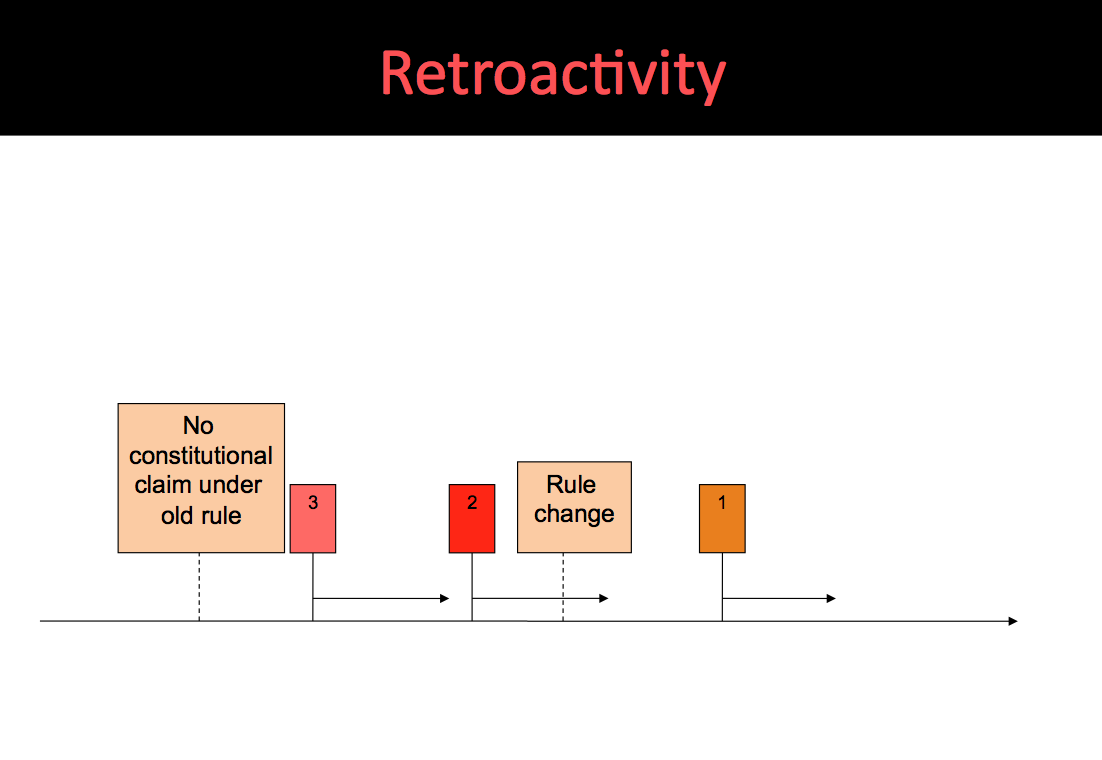
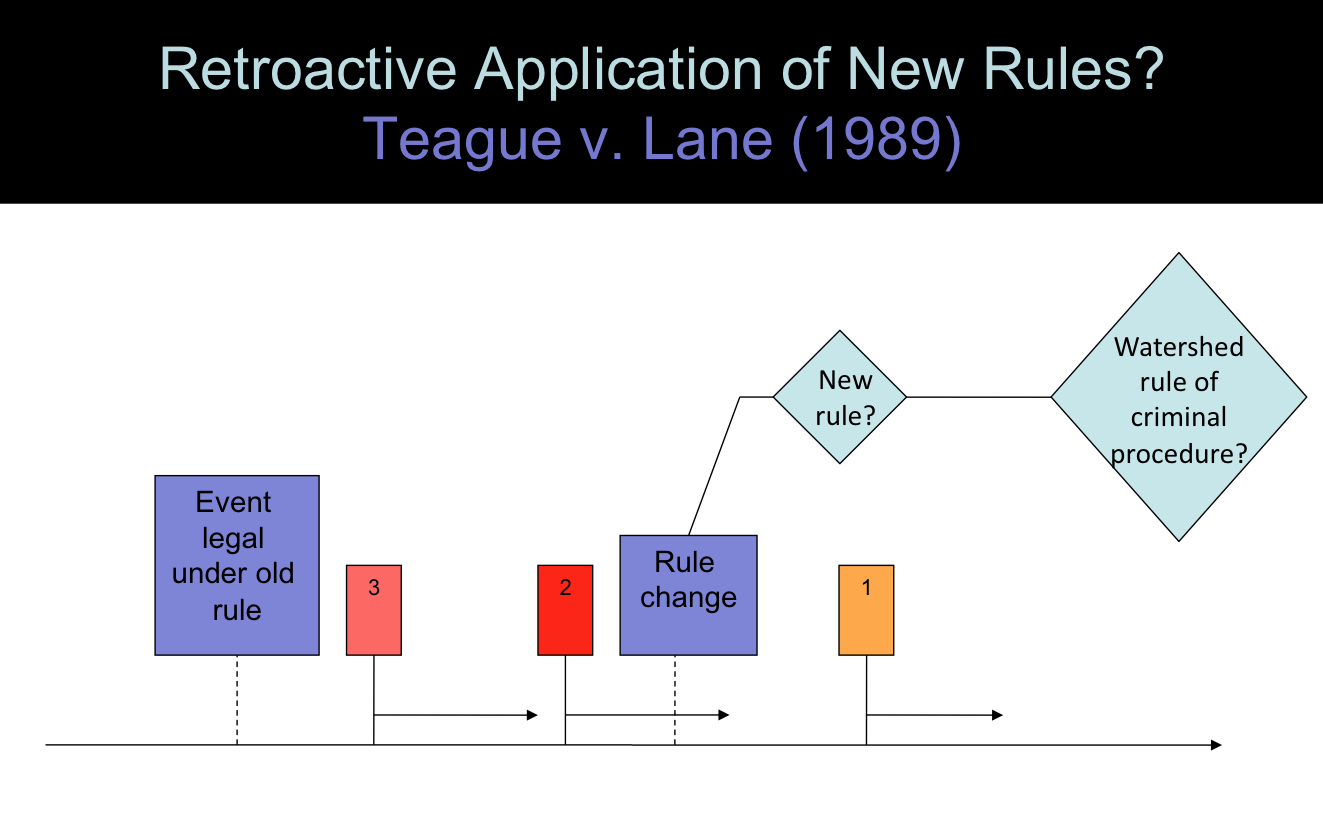
A little bit of background: New substantive rules apply retroactively. For example, if a certain behavior ceases to be a criminal offense, whoever is still doing time for that offense will probably be let out immediately. But for new procedural rules, appellants can benefit from them only if these rules come into being while their case is still “alive”, that is, still under direct review. In the diagram to the left, the rule change can benefit people in situations (1) and (2), but not (3). Note that, if the new rule came into being when (2) was still under direct appeal, but now (2) is arguing for it in a habeas proceeding, (2) still gets to benefit from the rule. (3), however, does not–his case became final before the rule change.

What about announcing a new rule on Habeas? According to Teague v. Lane (1989), the dilemma is as follows: the defendant who is asking for the new rule is, essentially, (3) from the previous diagram. That is, he would not be able to benefit from the new rule if it were announced today in someone else’s case. Which also means that all the people who are similarly situated to this defendant–whose cases are final and on habeas–will not benefit from the new rule. Since the court doesn’t want to just announce the rule and not enforce it, or to enforce it only in the particular case and not in those similarly situated (inequality), it reached the bizarre conclusion that it will simply not announce new rules on Habeas–unless these rules fundamentally change criminal justice, either in terms of legalizing previously prohibited behavior or being a “watershed rule of criminal procedure.”

Jones’ representative, Michael Laurence from the Habeas Corpus Resource Center, argued that the issue at stake here is substantive, not procedural. That is, the application of the death penalty is not merely a change in procedure, but rather a fundamental issue of applying the death penalty, as it was regarded in Furman v. Georgia (1972), Atkins v. VA (2001), and Schriro v. Summerlin (2003), the latter specifying that “rules that regulate the manner of punishment” are considered substantive, rather than procedural. Even if it is a procedural rule, it is essentially a reframing of the problem of arbitrariness, which led to the death penalty abolition in Furman, and therefore not a “new one” but merely the application of an old one.


In response, the government’s representative argued that the arbitrariness claim, in this context, is a “new rule”, and moreover, a procedural one. There hasn’t been precedent directly on point claiming that arbitrariness can manifest itself in delay, and since this is a new question, it cannot result in a new rule on Habeas under Teague.

There was some back and forth about whether the court’s decision in Andrews, which rejected a Jones-based claim, should be used to interpret whether the rule is new or old. 

2. Even if it’s a claim relying on an old rule, Jones has not exhausted his argument in state court (in fact, never brought this up in state court) and is therefore barred from raising it in federal court under the Habeas provisions in section 2254. As 2254(d)(1) says,


(d) An application for a writ of habeas corpus on behalf of a person in custody pursuant to the judgment of a State court shall not be granted with respect to any claim that was adjudicated on the merits in State court proceedings unless the adjudication of the claim—

(1) 

resulted in a decision that was contrary to, or involved an unreasonable application of, clearly established Federal law, as determined by the Supreme Court of the United States[.]

This was not the case here, claims the government; Jones didn’t even go to state court, and cannot therefore challenge the sentence at the federal court.

Jones’ representative argues that Jones benefits from an exception to the exhaustion clause, which appears in 2254(b)(2)(b)(ii):

(b)

(1)An application for a writ of habeas corpus on behalf of a person in custody pursuant to the judgment of a State court shall not be granted unless it appears that—

(A)

the applicant has exhausted the remedies available in the courts of the State; or

(B)

(i)

there is an absence of available State corrective process; or

(ii)

circumstances exist that render such process ineffective to protect the rights of the applicant.

This may seem very technical, but there’s actually a lot of anger beneath the technicalities. As Jones argues through Laurence, the California Supreme Court would not have provided a cure to the delay, but rather delayed things even further. In 1997, the Ninth Circuit found that 140 people on death row were unrepresented, and released them from the timely submission obligations under AEDPA. Now, there are 358 unrepresented people. The wait for an attorney can be 16 (!!!) years, and after that, litigation can last 8-10 years (!!!)–all this time, obviously, spent by the applicant on death row. Amazingly, the only office limited in its number of lawyerly hires, the Habeas Corpus Resource Center, can only hire 34 (!!!) lawyers, which is a woefully inadequate number of people to handle 758 (!!!) cases. Before and after Jones, the California Supreme Court did nothing to remedy this situation, argued Laurence, and therefore there was no point in trying to “exhaust” the claim in state court. That would be, literally, exhausting.

In response, the government representative said that the prospective delays in state resolution of such issues is speculative.

There was also a bit of back and forth on the merits, with the government resisting the assertion that death penalty in California is “arbitrary” but rather that cases are carefully examined.

I’m hoping that, no matter the result in the Ninth Circuit, this case will go to the Supreme Court, where the dysfunctional application of capital punishment in the state might find a receptive ear in Justice Kennedy and in Justice Breyer, who explicitly said, in Glossip v. Gross, that he would welcome an opportunity to address the constitutionality of the death penalty on the merits.

Today! Live Argument in Jones v. Davis

Starting at 10am, Jones v. Davis, the case in which the death penalty in California was declared unconstitutional because of the delays, streams live here:

If you’re at Hastings, join me at my office at 10am. If not, tune in to the blog later today for fresh commentary.

Jones v. Chappell Oral Arguments Coming Up at the Ninth Circuit

Remember Jones v. Chappell?

At the time we were very excited: A federal District Court judge, Judge Cormac Carney of Orange County, declared the death penalty in California unconstitutional because of the decades-long delay in its administration. In fact, we were so excited that we organized a public petition to the Attorney General, asking her not to appeal the decision. We got some press and support from more than 2,000 signees (thank you!) and there were even a few surreal plot twists.  Much to our disappointment, the Attorney General decided to appeal the decision.

On August 31, the Ninth Circuit will hear oral arguments in the case (now called Jones v. Davis–change of wardens). CCC will be there to report. If you want to read up a bit in the meantime, here’s the amicus brief submitted by Death Penalty Focus.

BREAKING NEWS: Connecticut Supreme Court Finds Death Penalty Unconstitutional

Today, the Connecticut Supreme Court ruled the death penalty unconstitutional, in a broad retroactive decision that removed all 11 inmates from death row and into general population. The Hartford Courant reports:

The majority decision, written by Justice Richard N. Palmer, found a host of flaws in the death penalty law, which banned “prospective” death sentences, those imposed after the effective date of the law. But the majority wrote that it chose to analyze capital punishment and impose abolition from a broad perspective.

After analysis of the law and “in light of the governing constitutional principles and Connecticut’s unique historical and legal landscape, we are persuaded that, following its prospective abolition, this state’s death penalty no longer comports with contemporary standards of decency and no longer serves any legitimate penological purpose,” Justice Richard Palmer wrote for the majority.

“”For these reasons, execution of those offenders who committed capital felonies prior to April 25, 2012, would violate the state constitutional prohibition against cruel and unusual punishment.”

Congratulations, Connecticut! Come on, California Supreme Court!

Good News on Health Care for Transgender Inmates

Today a settlement was reached in Quine v. Brown, a case involving housing and healthcare for transgender inmates. The Transgender Law Center reports:

Today, the California Department of Corrections and Rehabilitation reached a groundbreaking settlement with Shiloh Quine, a transgender woman held in a men’s prison, to move her to a women’s facility and provide medical care, including gender-affirming surgery, determined necessary by several medical and mental health professionals. In the settlement, the state also agreed to change its policies so that transgender prisoners can access clothing and commissary items consistent with their gender identity. The state also affirmed that it is revising its policies regarding transgender inmates’ access to medically necessary treatment for gender dysphoria, including surgery.

“This historic settlement is a tremendous victory, not just for Shiloh and transgender people in prison, but for all transgender people who have ever been denied medical care or basic recognition of our humanity just because of who we are,” said Kris Hayashi, Executive Director of Transgender Law Center, which represented Shiloh along with pro bono counsel from the law firm of Morgan, Lewis & Bockius LLP. “After years of unnecessary suffering, Shiloh will finally get the care she desperately needs – and transgender people nationwide will hear a state government affirm that our identities and medical needs are as valid as anyone else’s.”